Walk into any shop and the coffee machine aisle can feel like a wall of chrome, buttons and promises. Every box claims barista-quality results, and none of them tells you which one actually suits your kitchen.
As an Amazon Associate, I earn from qualifying purchases and sometimes recommend products from other sellers at no extra cost to you. For more details see my disclosure policy and privacy policy.
The truth is that the best coffee maker is the one that fits how you drink coffee, the space you have and what you want to spend. Get those three things straight and the choice becomes much simpler.
This guide walks you through that decision in order, then points you to the right buying guide for your type of machine.

The Coffee Chef Planner
Daily planning, journalling, and a proper coffee tasting log with a flavour wheel — 20 pages in one printable bundle.
Shop the planner →
Brewforge
A growing edit of coffee bar gear we’d genuinely want on our own counter, added to as we find things worth having.
Shop Brewforge →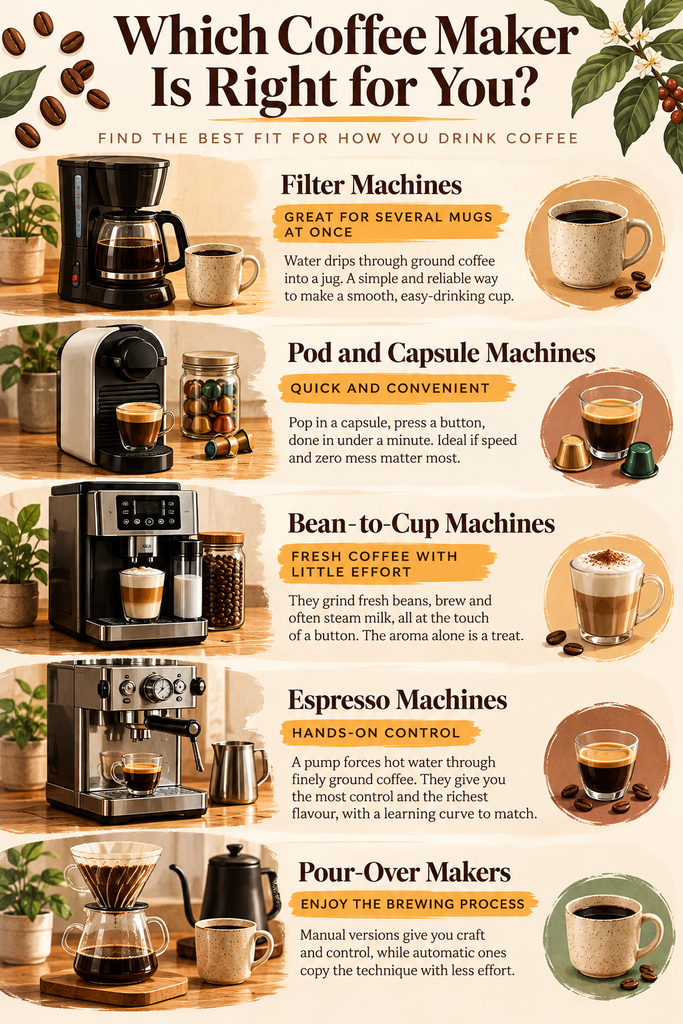
☕ Start With How You Drink Coffee
Before you look at a single price tag, picture your ideal cup. Is it a big mug of milky, gentle filter coffee, a quick pod on a school-run morning, or a proper flat white you made yourself?
Your answer narrows the field faster than any spec sheet. Here is how the main types line up.
- Filter machines: water drips through ground coffee into a jug. Great for several mugs at once, and the simplest route to a smooth, easy-drinking cup.
- Pod and capsule machines: pop in a capsule, press a button, done in under a minute. Ideal if speed and zero mess matter most.
- Bean-to-cup machines: they grind fresh beans, brew and often steam milk, all at the touch of a button. The aroma alone is a treat.
- Espresso machines: a pump forces hot water through finely ground coffee. They give you the most control and the richest flavour, with a learning curve to match.
- Pour-over makers: manual versions give you craft and control, while automatic ones copy the technique with less effort.
Be honest about your mornings. If you only have four minutes before leaving, a hands-on espresso machine may gather dust, however good the coffee.
If you like the ritual, though, a manual setup can be the best part of the day. Our guide to coffee brewing methods explains how each approach tastes and feels.
💷 How Much Should You Spend?
Price is where most people start, and it is a fair place to be. The trick is knowing what each tier actually gets you, and where extra money stops adding much.
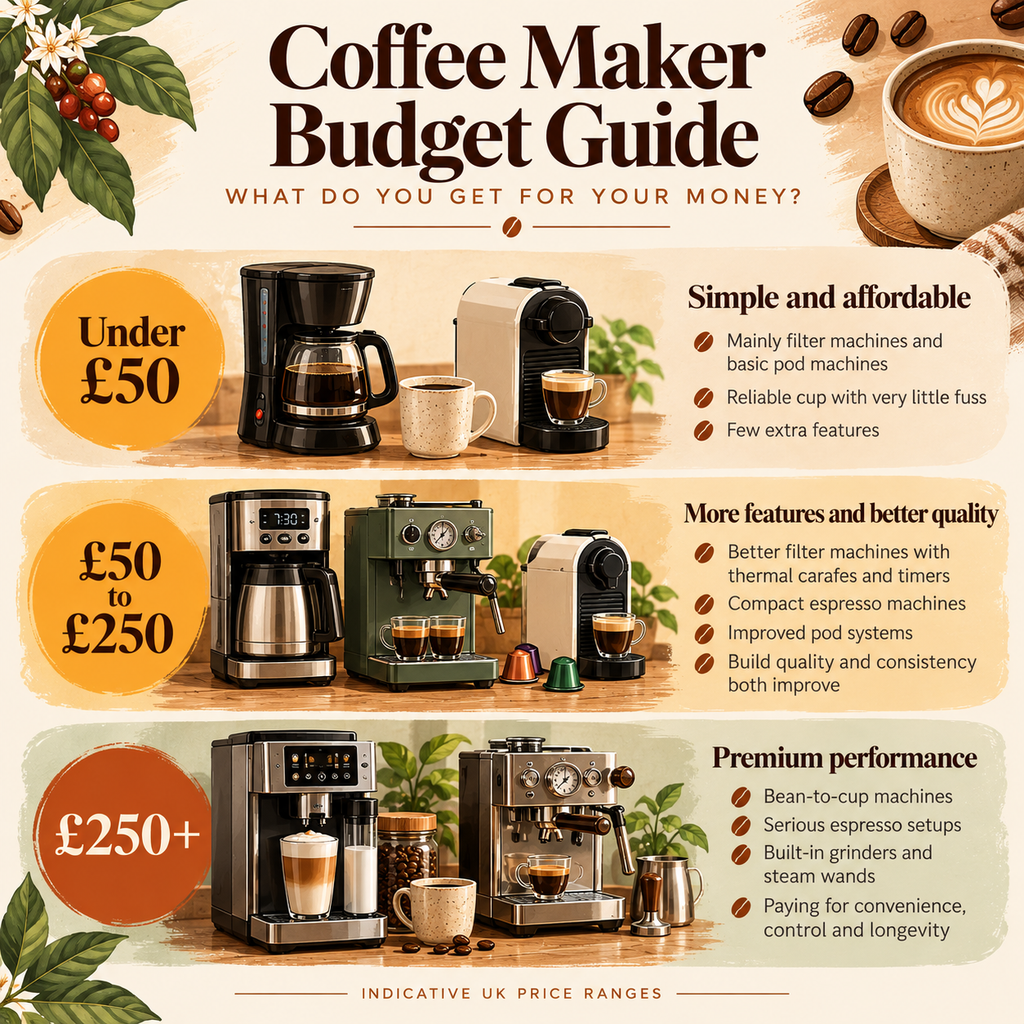
These are rough ranges rather than promises, because UK prices move around with sales and new models.
Under about £50. This is mainly the home of filter machines and simple pod machines. You will get a reliable cup with very little fuss, but few extras. Our best coffee maker under £50 guide covers what is worth buying at this level.
Mid-range, roughly £50 to £250. Here you find better filter machines with thermal carafes and timers, compact espresso machines, and the better pod systems. Build quality improves, and so does the consistency of each cup.
Premium, roughly £250 and up. This is the territory of bean-to-cup machines and serious espresso setups with built-in grinders and steam wands. You are paying for convenience, control and longevity.
More money does not automatically mean better coffee. A £40 filter machine with good beans will beat a £500 machine with stale ones.
Where extra spend does pay off is in the grinder, the temperature stability and the build. Where it does not is in a long list of presets you will never touch.
If you want to see how all this plays out across the range, our best coffee machines for home buyer’s guide sorts them by type.
📏 Think About Space Before You Fall in Love
A machine that looks lovely online can swallow half your worktop in real life. Measure before you buy, and measure up as well as across.
Check three things. First, the footprint, which is the width and depth it takes on the counter. Second, the height, because wall cupboards can stop you lifting a water tank out. Third, the cable length and nearest socket.
Pod machines and slim espresso machines tend to be the most compact. Bean-to-cup machines and filter machines with full-size jugs take more room.
Look at the water tank too. A small tank is fine for one or two cups a day. A big household will tire of refilling it constantly.
If your kitchen is tight, our guide to the best small coffee machines is a good starting point. For layout ideas that make the most of a little space, see coffee bar ideas for small kitchens.
🔄 Running Costs and Convenience
The purchase price is only the start. What you pay each week to keep making coffee matters just as much.
Pods are the most convenient, but each cup usually costs more than ground coffee or beans. Beans are the freshest and often the best value per cup, but they need a grinder, either built in or separate.
Ground coffee sits in the middle. It is cheap and easy, though it loses freshness faster once opened.
Whichever you choose, look after your beans. Our guide on how long coffee beans last shows how to store them so every cup still tastes lively.
Then there is cleaning. Filter machines need a rinse and a wipe. Bean-to-cup machines have more parts to empty and rinse, and milk systems need regular attention.
Every machine that heats water will build up limescale over time, especially in hard-water parts of the UK. Descaling regularly, following the maker’s instructions, keeps the taste clean and the machine healthy. A descaling solution is a cheap bit of insurance, and using filtered water helps too.
Ask yourself how much of this you will really do. A machine that is easy to clean is a machine you will keep using.
✨ Features Worth Paying For (and Gimmicks)
Not every button earns its place. Here is a quick sort.
Worth it:
- A thermal carafe: keeps filter coffee hot for hours without a hotplate cooking it into bitterness. See our guide to thermal carafe coffee makers.
- A built-in grinder: fresh grinding is the biggest leap in flavour you can buy. Look for adjustable settings.
- A good steam wand or milk system: if you love flat whites and lattes, this matters more than extra shot presets.
- A decent-size, removable water tank: small things that make daily life easier.
Often not worth it:
- Dozens of drink presets: most people use two or three.
- Large touchscreens: attractive, but extra to go wrong.
- Timers you never set: useful only if you actually wake up to a pot ready to go.
Smart features sit in the middle. A machine you can start from your phone is a nice trick, but it will not improve the coffee. If you are curious, our piece on smart coffee machines looks at whether they are worth the money.
🧭 Which Type Suits Me? A Quick Decision Guide
Use this as a shortcut. Find the sentence that sounds most like you, then follow the link.
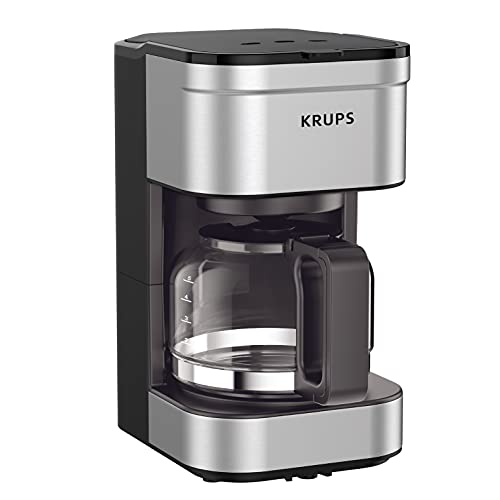
- “I want several mugs of easy coffee for the whole house.” Choose a filter machine. A thermal carafe version keeps it hot, and our thermal carafe guide will help you pick. A KRUPS filter machine is a solid example of the style.
- “I want one quick, mess-free cup.” Choose a pod machine. See our guide to the best single cup coffee systems, or the Dolce Gusto range if you want milky drinks. Comparing systems? Read Dolce Gusto vs Nespresso.
- “I want fresh beans without the faff.” Choose a bean-to-cup machine. Start with our bean-to-cup guide.
- “I want to make proper espresso and enjoy the process.” Choose an espresso machine. Our home espresso machine guide is the place to begin, and a slim model like the Dedica espresso machine shows how compact this style can be.
- “I like the craft of pour-over but not the wait.” Choose an automatic pour-over. Head to our guide to automatic pour-over coffee makers.
- “I am short on space or money.” Start with the small coffee machines guide or the under £50 guide.
If you drink a lot of milky coffee, think about your milk too. Our guide to milk alternatives for coffee is worth a read, and a handheld frother is a very cheap way to add foam to any brew.
🫘 Do Not Forget the Beans (and the Grinder)
A machine is only half of the story. The coffee you put into it decides most of the flavour.
Buy beans with a roast date, not just a best-before date, and use them within a few weeks of that roast. Smell them. Good beans should smell sweet, nutty or fruity rather than flat.
If you buy whole beans for a machine without a grinder, you will want one separately. Grind size matters a lot, and our coffee grind size guide shows how it changes your cup.
For espresso lovers, a good burr grinder such as the Baratza Encore ESP is often the smartest upgrade after the machine itself.
🏠 Make It Part of Your Kitchen
Once you have chosen, give your machine a proper home. A tidy coffee spot makes you far more likely to use it, and it looks lovely.
Keep the machine near a socket and the sink, with your cups, beans and cleaning kit within arm’s reach. Our guide to setting up a home coffee bar has ideas for every budget, and coffee station organisation will help you keep it clutter-free.
If you are building a full setup around one machine, see how to choose a coffee machine for your home bar.
🚫 Common Mistakes When Buying a Coffee Maker
A few errors come up again and again. Knowing them saves you money and a good deal of frustration.
Buying for the person you wish you were. A manual espresso machine is wonderful if you love the ritual. If you do not, it becomes a very expensive ornament.
Ignoring the running costs. A cheap machine that only takes pricey pods can cost more over a year than a mid-range machine that takes ground coffee.
Skipping the measuring tape. Check the height under your cupboards and the space around the machine for opening lids and lifting tanks.
Forgetting about cleaning. If the thought of rinsing milk parts every morning makes you groan, choose a simpler machine.
Chasing features instead of coffee. The grinder, the water temperature and the brew method shape the flavour. The extra buttons rarely do.
❓ Quick Questions
What is the easiest type of coffee maker to start with? A filter machine or a pod machine. Both need little skill and very little cleaning.
Is a bean-to-cup machine worth it? If you value fresh coffee at the touch of a button and have the budget, yes. If you only drink a cup or two now and then, a simpler machine will serve you better.
How often should I replace my coffee maker? With regular cleaning and descaling, a good machine can last many years. Poorly maintained ones tend to fail early.
Can I make milky drinks without a steam wand? Yes. A handheld frother, a pod machine with a milk setting or a bean-to-cup machine with an automatic milk system will all do the job.
🎯 Final Thoughts
Choosing a coffee maker is easier when you work backwards from your own habits. Decide how you like to drink coffee, check the space you have, set a sensible budget and think about the running costs.
Then pick the matching type and let the guides above handle the details. Whichever you choose, fresh beans and a clean machine will do more for your cup than any feature on the box.