You’ve decided you want a pod coffee machine. Smart move — there’s a reason they’ve taken over kitchen counters across the UK. But now you’re staring down two of the biggest names in the category: Dolce Gusto and Nespresso. Both promise café-quality drinks at home, both use capsules, and both come in at wildly different price points depending on which machine you go for.
As an Amazon Associate, I earn from qualifying purchases and sometimes recommend products from other sellers at no extra cost to you. For more details see my disclosure policy and privacy policy.
So which one’s right for you? That depends entirely on what you’re actually looking for — and the answer isn’t as obvious as either brand’s marketing would have you believe. This guide breaks it all down so you can make the call without second-guessing yourself.
What Each System Is Actually Built For
Before getting into the specs, it helps to understand what each brand is trying to do — because they’re genuinely aimed at different people.

The Coffee Chef Planner
Daily planning, journalling, and a proper coffee tasting log with a flavour wheel — 20 pages in one printable bundle.
Shop the planner →
Brewforge
A growing edit of coffee bar gear we’d genuinely want on our own counter, added to as we find things worth having.
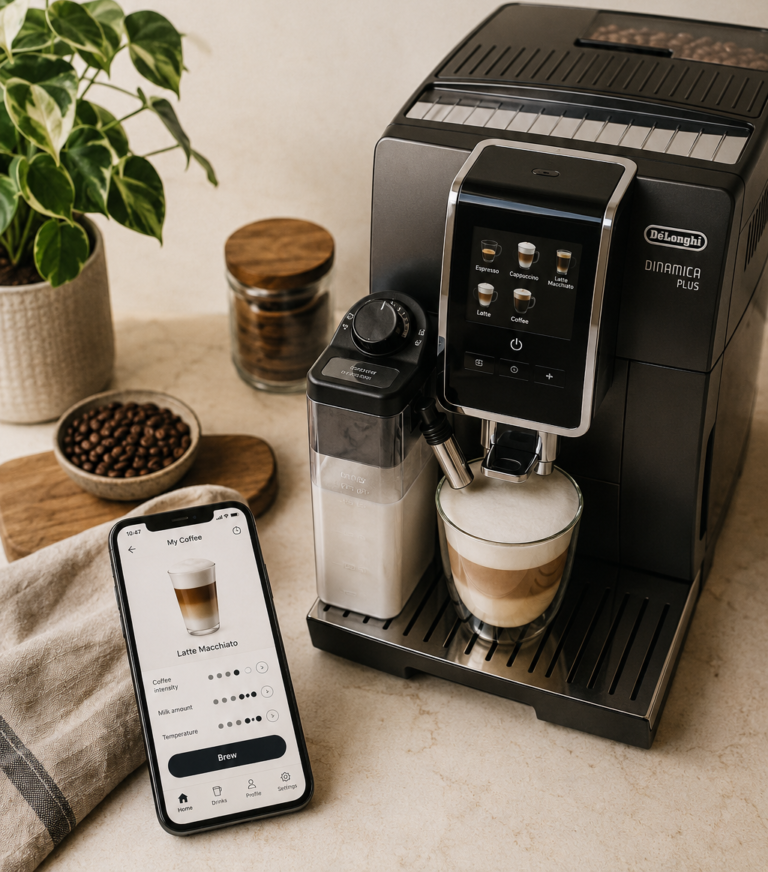
Shop Brewforge →Nespresso is positioned as a premium, espresso-focused system. It’s designed for people who care deeply about the quality of their coffee and are happy to pay a bit more per cup to get it. The range is deliberate: espresso, lungo, ristretto, large cup formats — it’s coffee, coffee, and more coffee. There are flavoured options (vanilla, caramel, that sort of thing), but the heart of the system is about producing a genuinely good espresso with real crema and consistent results.
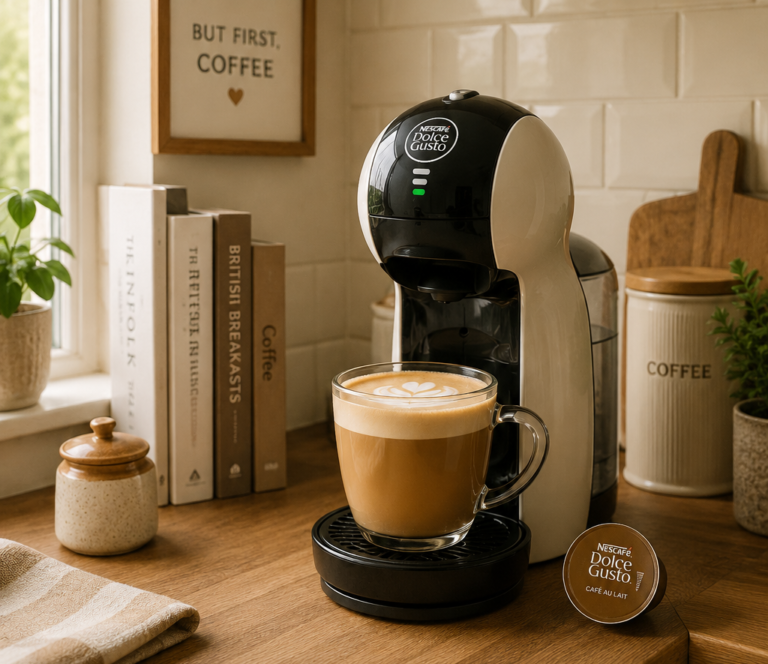
Dolce Gusto takes a completely different approach. It’s built for households that want variety — and lots of it. The pod range includes espresso and long blacks, but also lattes, cappuccinos, macchiatos, hot chocolate, tea, and even cold drinks. It’s positioned as a budget-friendly, versatile system that suits families, offices, and anyone who likes having options. The coffee is decent, but variety and price are the main selling points rather than speciality-grade espresso quality.
Knowing this upfront saves a lot of confusion. If you want an honest espresso experience at home, you’re probably a Nespresso person. If you want a machine that can make your flatmate’s oat milk latte and your hot chocolate and your black coffee — and you don’t want to spend much doing it — Dolce Gusto is worth a proper look.
Coffee Quality and Drink Variety
How the Coffee Actually Tastes
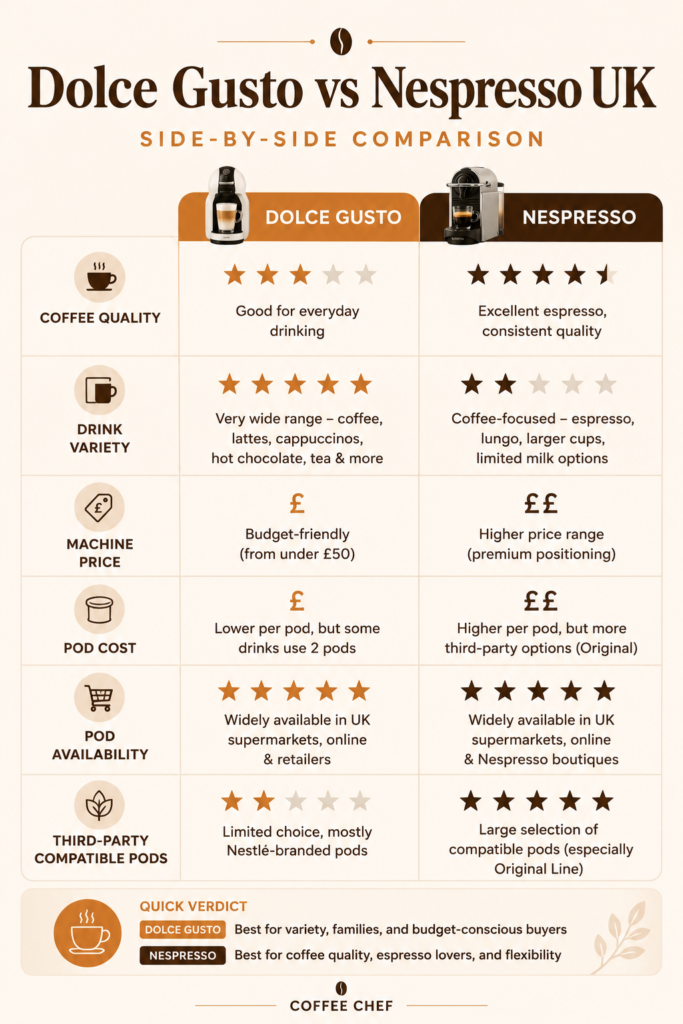
This is where Nespresso consistently wins in UK reviews. The Original Line in particular has a well-earned reputation for producing a genuinely good espresso — crema intact, flavour consistent, profile clean. The Vertuo line uses barcode scanning to customise brew parameters per pod, which makes it even harder to get a bad result. If espresso-style drinks are your main event, Nespresso is the stronger performer.
Dolce Gusto coffee is often described as “good enough” — mellow, smooth, and perfectly fine for everyday drinking, but not competing with Nespresso for espresso quality. If you’re having a flat white with milk and a bit of syrup, you might not notice the difference. If you’re drinking it straight as a short espresso, you probably will.
The Variety Factor
Here’s where Dolce Gusto genuinely earns its place. The pod range is significantly broader than Nespresso’s, covering drinks that Nespresso simply doesn’t make. Lattes, cappuccinos, and macchiatos use a two-capsule system — one for the coffee, one for the milk powder — which means you don’t need a separate frother or any faff. Just pop both capsules in and let the machine do the work.
Hot chocolate, iced coffee drinks, chai latte, teas — these are all in the Dolce Gusto range. For a household where not everyone drinks straight coffee, this matters. Nespresso’s range, by contrast, is almost entirely coffee-based, with Vertuo adding some larger cup sizes and milk pods only in limited formats.
If you’re the sole coffee drinker in your house and you just want a great espresso, this variety point is largely irrelevant. If you share a kitchen with anyone who prefers something milky or sweet, Dolce Gusto has a clear advantage here.
Machine Prices and Running Costs
Upfront Machine Cost
Dolce Gusto machines are consistently among the cheapest pod machines you can buy in the UK — sitting alongside Tassimo at the budget end of the category. You can pick up an entry-level Dolce Gusto for well under £50 during sales, and the standard range rarely pushes past £100. Nespresso machines tend to start higher and go significantly further up, reflecting the more premium build quality and positioning.
That said, Nespresso machines go on sale regularly and can often be found at discounted prices through John Lewis, Currys, or the Nespresso website directly. It’s worth checking before assuming the gap is as wide as the full-price difference suggests.
The Cost Per Cup Conversation
This is where things get more nuanced. Nespresso pods — especially Vertuo — tend to cost more per capsule than Dolce Gusto pods. For drinks where Dolce Gusto uses two capsules (the milky drink formats), that adds up quickly, so the price advantage isn’t always as obvious as it first appears.
Nespresso Original has another advantage here: a large ecosystem of compatible third-party pods from independent roasters, which can bring the cost per cup down while also expanding the flavour range considerably. You can get specialty coffee roasters’ pods in Nespresso Original format — which is something Dolce Gusto simply can’t match. The Dolce Gusto compatible market is narrower, and most buyers stick with Nestlé-branded capsules for the full range of drink styles.
Adjust the sliders to see how much each system costs you over time.
Dolce Gusto
Cost per pod
Pods per drink
Nespresso
Cost per pod
Pods per drink
Dolce Gusto
per month
£4.27
per year
£51.10
Nespresso
per month
£6.68
per year
£80.30
Annual difference
Nespresso costs £29.20 more per year
Prices are approximate UK averages. Dolce Gusto milky drinks use 2 pods — slide to 2 to reflect lattes and cappuccinos. Nespresso third-party pods can bring the cost per cup down considerably.
Over the long term, if you’re a frequent espresso drinker, the Nespresso ecosystem’s flexibility — especially on the Original Line — can actually make it competitive on running costs once you factor in third-party options.
Availability and Where to Buy Pods
For both systems, UK pod availability is strong. You won’t find yourself in trouble with either brand.
Nespresso pods are sold through Nespresso boutiques (there are standalone shops in most major UK cities), online via the Nespresso website, and through supermarkets and retailers like John Lewis and Argos. The branded pods come in a wide variety of blends and intensities, and the third-party compatible market for Original Line machines is genuinely huge — you’ll find options from Aldi, Lidl, Waitrose Own Label, and specialty roasters like Pact and Kiss the Hippo.
Dolce Gusto pods are heavily present in UK supermarkets — you’ll find them in most Tesco, Sainsbury’s, and Waitrose branches — as well as online. The branded range is extensive if you want variety. The third-party compatible options exist but are more limited, and for the signature milky drink formats, you’re largely sticking with Nestlé’s own pods.
One important note: Nespresso and Dolce Gusto pods are not cross-compatible. The pod shapes and brewing mechanisms are completely different, so there’s no mixing and matching. Whatever system you commit to, you’re committing to that ecosystem.
Which Machine Should You Actually Buy?
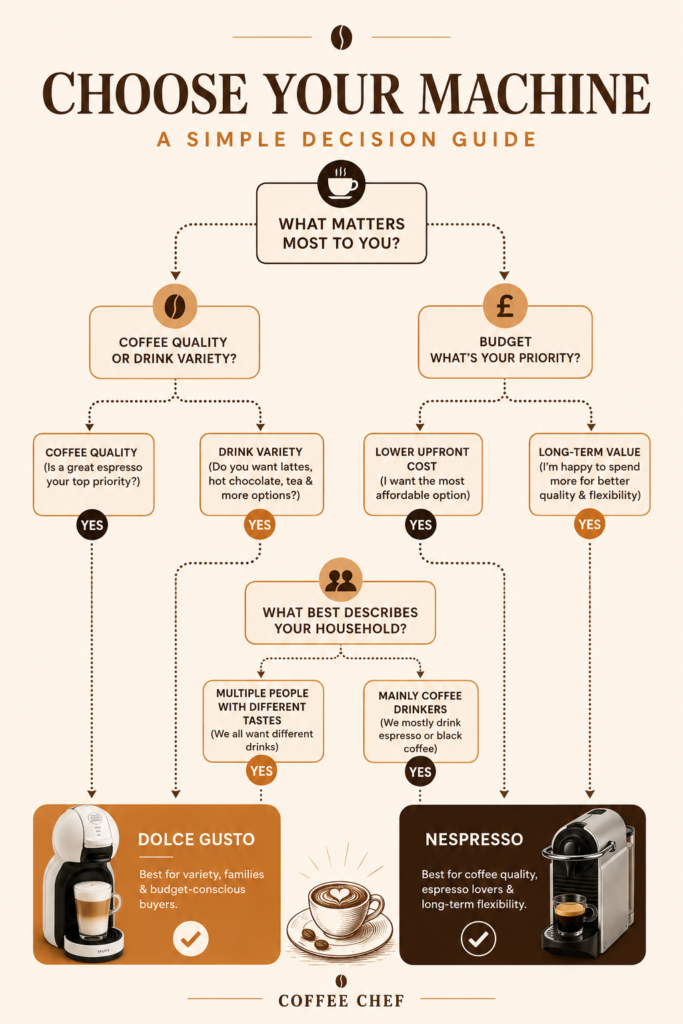
Choose Nespresso If…
- You mainly drink espresso, lungo, or black coffee and you care about getting it right
- You want a machine that consistently impresses
- You’re interested in exploring specialty roasters via compatible pods
- You like the idea of a compact, sleek machine that does one thing very well
- You’re setting up a home coffee bar and coffee quality is the priority
The Nespresso Vertuo Pop is a strong entry-level option if you want something compact and affordable. The Nespresso Essenza Mini is the classic starting point on the Original Line and works with the full third-party compatible ecosystem.
Choose Dolce Gusto If…
- You want a machine that can handle multiple drink styles — lattes, cappuccinos, hot chocolate, teas
- You share your kitchen with people who don’t drink straight coffee
- Budget is a priority for both the machine and the ongoing pod cost
- You’d rather have variety than speciality-grade espresso quality
- You’ve already explored the Dolce Gusto pod range and there are drinks on there that genuinely excite you
The Dolce Gusto Infinissima and Genio S are the current popular mid-range options — both straightforward to use and widely available in the UK.
What If You Can’t Decide?
A genuinely useful framing: think about the last few coffee-style drinks you actually enjoyed. If they were straight espressos or Americanos, you’d probably get more from Nespresso. If they were flavoured lattes, hot chocolates, or anything with a lot going on — Dolce Gusto is likely the better fit for your daily habits.
If espresso quality is important but you also want milk-based drinks, consider pairing a Nespresso Original with a standalone milk frother. The Nespresso Aeroccino is a popular choice and takes very little counter space — or check the coffee bar accessories guide for more options worth considering. It’s an extra spend, but you’d get better coffee quality with more drink variety than either system delivers alone.
The Verdict
For pure coffee quality and a premium experience, Nespresso wins. The espresso is better, the pod ecosystem is richer (especially on the Original Line), and the machines are built to a higher standard. If coffee is the point, Nespresso is the better investment.
For variety, price, and household flexibility, Dolce Gusto wins. It’s cheaper to get started, the pods are easy to find in any supermarket, and the range of drink styles is genuinely hard to beat for mixed households. The coffee isn’t as refined, but for most everyday drinkers — especially if you like your coffee with a lot of milk and flavour — it’s more than good enough.
Both are well-supported in the UK market and easy to maintain. Whichever you choose, you’re not making a bad call — you’re just making a different one. If you want to dig further into the Dolce Gusto world before deciding, the full Dolce Gusto machine comparison breaks down the individual models side by side.
Continue Your Journey
- Best Dolce Gusto Machine UK 2026: Which One Is Actually Worth Buying? — if you’re leaning Dolce Gusto, this is your next read
- Dolce Gusto Pod Flavours — Which Are Actually Worth It? — a proper rundown of which capsules to try first (and which to skip)
- Dolce Gusto Machines Compared: Which One Is Right for You? — side-by-side look at the current Dolce Gusto range
- How to Set Up a Home Coffee Bar: The Ultimate UK Guide — getting the full picture before you commit to a machine
- How to Choose a Coffee Machine for Your Home Bar (UK Guide) — broader advice on picking the right machine for your setup
Which system are you leaning towards — and what swayed you? Drop your thoughts in the comments. And if you want a weekly nudge of coffee ideas, recipes, and kit worth knowing about, you can sign up to the Coffee Chef newsletter below.