Nothing beats the smell of fresh coffee grinding away before you’ve even had your first sip. A bean-to-cup machine grinds whole beans and brews straight into your cup at the press of a button, no separate grinder, no tamping, no faffing about with a portafilter.
As an Amazon Associate, I earn from qualifying purchases and sometimes recommend products from other sellers at no extra cost to you. For more details see my disclosure policy and privacy policy.
The UK market for these machines has grown fast over the last couple of years, and it’s easy to see why. You can now get a genuinely good one from around £280, and the days of paying £4 for a flat white you could make at home in under a minute are numbered. This guide covers what’s actually available to UK buyers right now, with real prices from real UK retailers rather than US listings that don’t ship here.
☕ What Is a Bean-to-Cup Machine, and How Is It Different From an Espresso Machine?
A bean-to-cup machine does everything for you. You fill the hopper with whole beans, fill the water tank, pick a drink from the menu, and the machine grinds, doses, tamps and brews automatically. Most also froth milk for you, either with an automatic carafe or a manual steam wand.

The Coffee Chef Planner
Daily planning, journalling, and a proper coffee tasting log with a flavour wheel — 20 pages in one printable bundle.
Shop the planner →
Brewforge
A growing edit of coffee bar gear we’d genuinely want on our own counter, added to as we find things worth having.
Shop Brewforge →A semi-automatic espresso machine, like the Sage Barista Express, hands you more control but expects more from you in return. You grind separately, dose by hand, tamp yourself, and pull the shot. The output can be better once you’ve got the technique, but it takes practice to get there.
Choose bean-to-cup if you want café-quality coffee with zero learning curve and don’t want a separate grinder cluttering the counter. Choose semi-automatic if you enjoy the process and want full control over every variable. If you’re weighing that decision, our espresso machines guide covers the semi-automatic side properly.
🧾 What to Check Before You Buy
Milk system
Automatic milk systems (like De’Longhi’s LatteCrema or Philips’ LatteGo) froth and pour at the touch of a button. Manual steam wands cost less but need practice, and they’re genuinely fine if you mostly drink black coffee anyway.
Grind settings and hopper
More grind settings mean finer control over strength and body. If you regularly switch between a dark espresso blend and a lighter filter-style bean, look for a machine with two bean hoppers rather than refilling one every time.
Ease of cleaning
This is the detail that decides whether a machine gets used every day or ends up gathering dust after three months. Milk systems with fewer parts and no narrow tubing rinse clean in seconds; carafe-and-hose systems need more regular attention or they’ll start affecting the taste.
Hard water and descaling
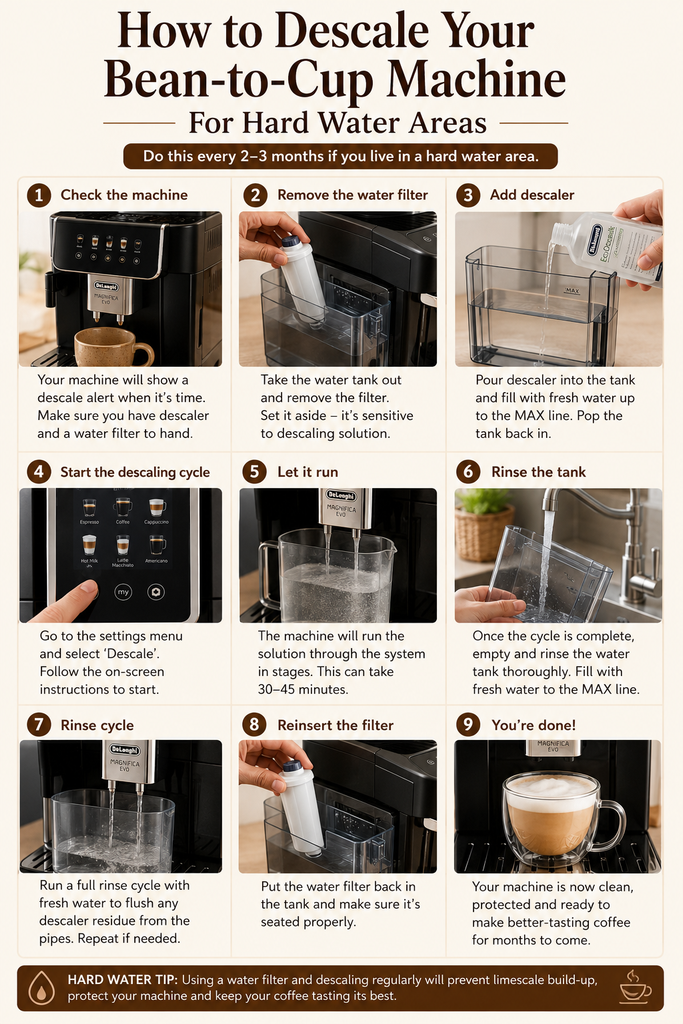
Most of the UK has hard water, and it’s the single biggest factor in how long these machines last. Look for a model with a built-in water filter, and budget for descaling every two to three months if you’re in London, the South East, East Anglia or the Midlands.
Price range
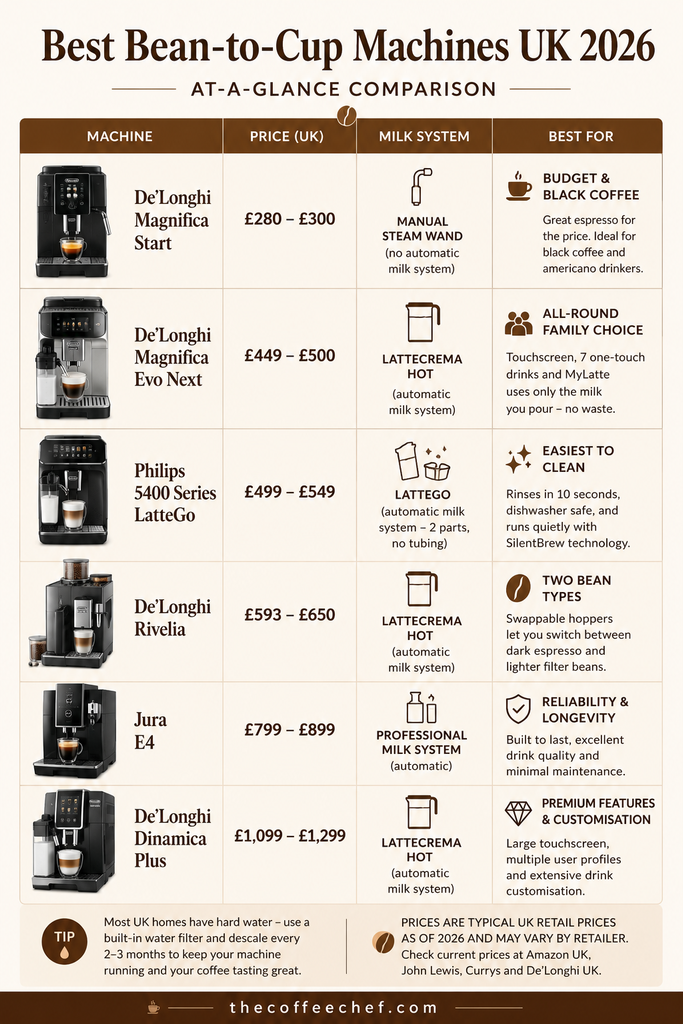
Realistic UK pricing runs from about £280 for a reliable entry machine to over £2,000 for the most automated options. Most households land happily in the £400 to £650 bracket.
🏆 The Best Bean-to-Cup Machines for UK Kitchens
Best budget: De’Longhi Magnifica Start (around £280 to £300)
The Magnifica Start is the cheapest genuinely good fully automatic machine on the UK market. It has a 1.8 litre water tank, five grind settings and three strength levels, and it produces properly good espresso for the price.
The catch is the manual steam wand rather than an automatic milk system, so it suits black coffee and americano drinkers best. If lattes and cappuccinos are your daily order, it’s worth stretching to the next model up.
Best all-rounder: De’Longhi Magnifica Evo Next (around £449 to £500)
This is the machine most UK households land on, and for good reason. It has a colour touchscreen, thirteen grind settings, seven one-touch drinks and De’Longhi’s LatteCrema Hot automatic milk system, which produces noticeably denser foam than older De’Longhi machines.
The standout feature is MyLatte, which uses exactly the amount of milk you pour in rather than a fixed dose, so there’s no waste. For a household of two or more that wants variety without any daily faff, this is the safest recommendation on the list.
Easiest to clean: Philips 5400 Series LatteGo (around £499 to £549)
If cleaning is what puts you off a bean-to-cup machine, this is the one to look at. The LatteGo milk system has just two parts with no internal tubing, so it rinses clean under the tap in about ten seconds and both pieces go straight in the dishwasher.
It also runs quietly thanks to Philips’ SilentBrew technology, which matters more than it sounds if you’re in a flat with thin walls or brewing before anyone else is awake. It offers twelve one-touch drinks and a 1.8 litre tank with a built-in AquaClean filter.
Best for two bean types: De’Longhi Rivelia (around £593 to £650)
The Rivelia’s party trick is a pair of magnetic, swappable bean hoppers, so you can keep a dark espresso blend in one and a lighter single-origin bean in the other without emptying and refilling. It’s the only machine at this price with that feature.
It carries over the Evo Next’s LatteCrema Hot milk system and adds a fourteen-setting grinder and five programmable strength profiles. Worth the jump if you genuinely use two different beans, otherwise the Evo Next covers most of the same ground for less.
Best under £1,000: Jura E6 (around £899 to £999)
Jura is Swiss, and it shows in the build. The E6 uses Jura’s Pulse Extraction Process, a patented technique that pulses water through the grounds rather than pushing it continuously, aimed at getting more flavour out of shorter espresso shots.
The CLARIS water filter is the real selling point for UK buyers in hard water areas, since it meaningfully cuts limescale buildup and stretches out descaling intervals. Jura’s automatic milk system rinse programme also means less manual cleaning than the De’Longhi range. It costs roughly double the Evo Next, and the difference shows up more at the three to five year mark than it does on day one.
Worth knowing about
Krups also has a proper bean-to-cup range built by the same company that manufactures UK Nespresso machines, including the Intuition Experience+ and Evidence One. Our Krups buying guide covers the full line-up if you want to compare.
At the very top of the market, the Sage Oracle Touch (around £1,999 to £2,199) adds automatic tamping alongside automatic grinding and milk frothing, making it the closest thing to a fully automated café setup for home use. It’s a serious investment rather than an everyday recommendation, but worth knowing it exists if budget genuinely isn’t a factor.
💧 Bean-to-Cup Machines and UK Hard Water
Every machine in this guide needs descaling, and how often depends on where you live. Use the manufacturer’s water filter from day one rather than waiting until you notice a problem, since limescale builds up inside the boiler long before it shows up in your cup.
Skipping descaling doesn’t just affect taste. Most manufacturers, including De’Longhi and Jura, will treat a lack of descaling as a warranty issue if a machine fails early.
🫘 Getting the Best Cup Out of Your Machine
Use whole beans with at least a couple of days off the roast date, never pre-ground coffee, since these machines rely on grinding fresh for every cup. Avoid oily dark roast beans where you can, as the oil coats the burrs over time and affects the grind quality. If you want to go deeper on how roast and origin affect flavour, our guide to coffee bean types and our breakdown of coffee grind sizes are both worth a read.
Cost-wise, quality supermarket espresso beans work out at roughly 15 to 25p a cup, against 40 to 60p for a Nespresso pod. At two coffees a day, that’s a saving of around £180 to £270 a year, which means even the pricier machines on this list pay for themselves within a year or two if you’re currently on pods.
❓ Bean-to-Cup Machine FAQ
What’s the difference between a bean-to-cup machine and an espresso machine? A bean-to-cup machine is fully automatic. A semi-automatic espresso machine needs you to grind, dose, tamp and pull the shot yourself, which gives more control but takes longer to learn.
Which bean-to-cup machine is easiest to clean? The Philips 5400 LatteGo is the easiest in this guide, thanks to its two-part, dishwasher-safe milk system. Jura’s automatic cleaning programmes also take most of the manual work out of it.
Is De’Longhi or Jura the better buy? De’Longhi offers the best value between £280 and £650, with widely available, reliable machines. Jura’s premium buys you better build quality and a longer expected lifespan, which tends to justify itself if you’re keeping the machine for eight to ten years rather than three or four.
Do bean-to-cup machines cope with UK hard water? Yes, provided you use the filter and descale regularly. Jura’s CLARIS filter gives the strongest protection of the machines covered here, though De’Longhi and Philips both include a basic filter as standard.
Ready to Choose
For most UK kitchens, the De’Longhi Magnifica Evo Next is the sensible middle ground: proper milk drinks, a decent grinder and a price that doesn’t need much justifying. If cleaning is your main hesitation, go for the Philips 5400. If you’re planning to keep the machine for the best part of a decade, the Jura E6 earns its higher price.
Whichever you land on, pair it with good beans and a quick weekly wipe-down and it’ll keep pulling café-quality coffee for years. If you’re setting up your whole coffee corner rather than just picking a machine, our guide to choosing a coffee machine for your home bar and our home coffee bar setup guide are both worth a look, and our Coffee Planner has a tasting log built in if you want to track which beans work best in your new machine.