Small kitchens make you honest. Every inch of worktop is already spoken for by the kettle, the toaster and that bread bin you keep meaning to relocate. So when a coffee machine arrives, it has to earn its footprint.
As an Amazon Associate, I earn from qualifying purchases and sometimes recommend products from other sellers at no extra cost to you. For more details see my disclosure policy and privacy policy.
This guide picks machines by the space they actually take up, using real measurements from the manufacturers rather than estimates. Whether you live in a flat, a terraced house or a galley kitchen, there is a machine here that fits and still makes a proper cup.
Affiliate disclosure: some links in this post are affiliate links. If you buy through them, The Coffee Chef may earn a small commission at no extra cost to you. It never changes what we recommend.

The Coffee Chef Planner
Daily planning, journalling, and a proper coffee tasting log with a flavour wheel — 20 pages in one printable bundle.
Shop the planner →
Brewforge
A growing edit of coffee bar gear we’d genuinely want on our own counter, added to as we find things worth having.
Shop Brewforge →📏 Measure Your Space Before You Shop
Most people check the width of a machine and stop there. That is how you end up with a lovely espresso maker that will not fit under the wall cupboard.
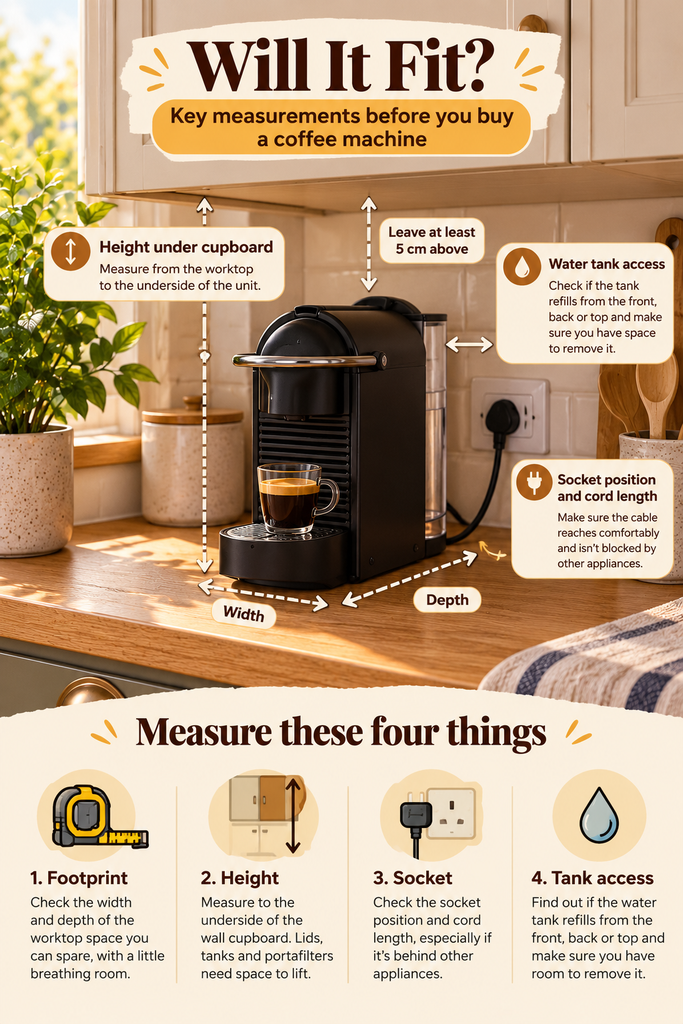
Grab a tape measure and check four things before you buy anything.
- Footprint: the width and depth of the patch of worktop you can spare, with a little breathing room at the sides for heat and steam.
- Height under the wall unit: measure from the worktop to the underside of the cupboard. Lids lift, tanks slide out of the top, and portafilters need space to twist in.
- Socket position and cord length: a short cable and a socket behind the toaster can decide the matter for you.
- Tank access: will you refill from the front, the back or the top? A rear tank in a corner is a daily annoyance.
Write the numbers down. Then compare them against the W x D x H figures below, all taken from manufacturer specifications.
A good rule is to leave at least 5 cm of clearance above the highest point of the machine, more if the lid or tank lifts upwards. Machines also need a little air around them to shed heat, so avoid wedging one tightly into a corner.
☕ How We Grouped the Picks
Rather than ranking by price, these picks are grouped by the type of machine and, more importantly, by how much room each one needs. A slim capsule machine and a compact espresso machine solve different problems, so it helps to see them side by side.
Every machine below has a stated width, depth and height from the manufacturer, plus a note on tank size, storage and day-to-day use. We have only used figures we could confirm from official or retailer specification pages. Where sources disagreed, we say so.
📋 Quick Comparison Table
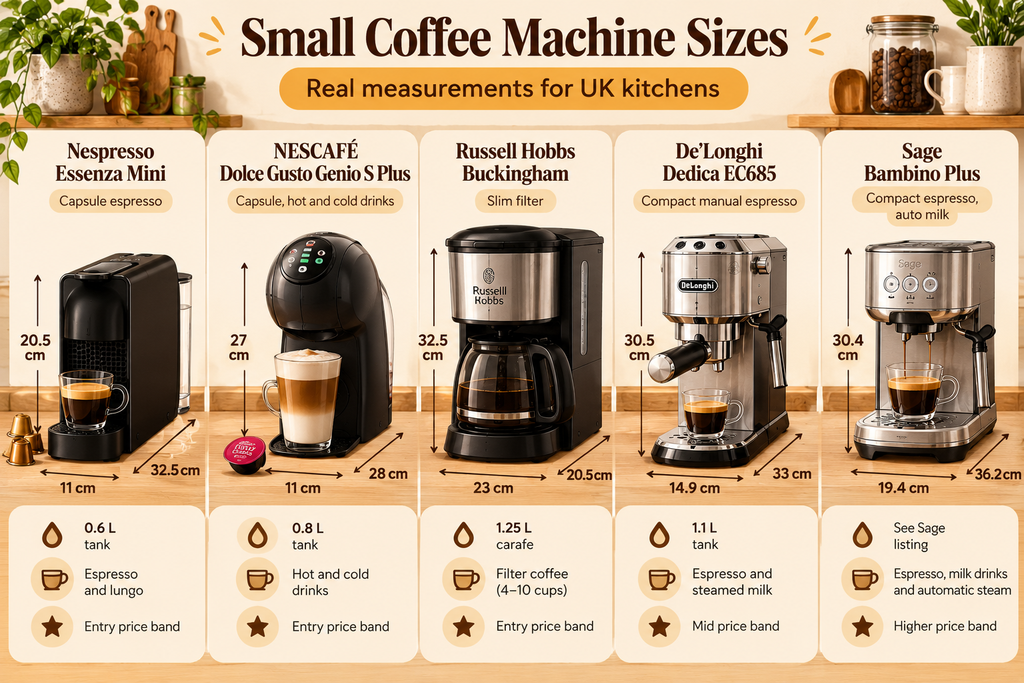
| Machine | Type | W x D x H (cm) | Water tank | Price band |
|---|---|---|---|---|
| Nespresso Essenza Mini | Capsule espresso | 11 x 32.5 x 20.5 | 0.6 L | Entry |
| NESCAFÉ Dolce Gusto Genio S Plus | Capsule, hot and cold drinks | 11 x 28 x 27 | 0.8 L | Entry |
| Russell Hobbs Buckingham | Slim filter | 23 x 20.5 x 32.5 | 1.25 L carafe | Entry |
| De’Longhi Dedica EC685 | Compact manual espresso | 14.9 x 33 x 30.5 | 1.1 L | Mid |
| Sage Bambino Plus | Compact espresso, auto milk | 19.4 x 36.2 x 30.4 | See Sage listing | Higher |
Price bands are relative to each other and are only a rough guide. Always check the current price at your retailer.
🫘 The Tiniest Footprints: Compact Pod Machines
If worktop space is your biggest problem, start here. Capsule machines are the narrowest on the market, and some are barely wider than a tall glass.
Nespresso Essenza Mini
Nespresso lists the Essenza Mini at 11 cm wide, 32.5 cm deep and 20.5 cm high, with a 0.6 litre tank. That height is the headline. It slides under almost any wall cupboard, even the low ones above a kettle station.
It makes espresso and lungo with one button, heats in around half a minute and switches itself off. The tank lifts out for filling at the sink, and the used-capsule bin is small enough that you will empty it every day or two.
What you give up is milk. There is no steam wand, so lattes need a separate frother. A handheld milk frother takes up one drawer slot and turns a shot into a decent flat white. For tips on getting good foam without fuss, see our guide to frothing milk for coffee.
Best for: one or two coffees a day, espresso drinkers, and anyone with a very shallow worktop.
NESCAFÉ Dolce Gusto Genio S Plus
The Dolce Gusto manufacturer page gives the Genio S Plus as about 11 cm wide, 28 cm deep and 27 cm high, with a 0.8 litre tank. A UK retailer listing gives 11.2 x 28.8 x 27.3 cm, so the two agree closely. One user manual we found quoted different figures, so measure your gap against the manufacturer numbers and leave a little spare.
It is narrow, light, and it makes both hot and cold drinks, which suits households where one person wants a cappuccino and another wants a hot chocolate. The tank is larger than the Nespresso’s, so you refill less often.
If you want to see how the full range compares, our Dolce Gusto machines compared guide goes through each model. The Genio S Plus is a sensible choice when you want variety in a narrow space.
Best for: mixed households, milky drinks, and people who like choice without clutter.
🍂 The Slim Filter Option
Filter coffee has a reputation for taking up room, but not all filter machines are bulky. A well-designed slim one can be narrower than a toaster.
Russell Hobbs Buckingham
The retailer specification lists the Russell Hobbs Buckingham at 23 cm wide, 20.5 cm deep and 32.5 cm high, with a 1.25 litre glass carafe. That depth is unusually shallow, which helps on a narrow worktop.
It brews up to ten cups, so it works for a couple or a small gathering. It also has a 2 to 4 cup option for smaller batches and a 24-hour timer, so you can wake up to coffee without standing over it.
Water goes in at the top, so you need clear space above it. Check the gap under your wall unit before you commit. If the carafe sits on the machine’s base, you will also want somewhere to put the filter basket when you rinse it.
For anyone weighing up filter against pod, the Russell Hobbs Buckingham gives you the cheapest cost per cup of any machine here, plus the satisfaction of a full pot.
Best for: couples, slow weekend mornings, and anyone who drinks several mugs rather than one.
⚙️ Compact Espresso Machines
Real espresso needs a pump, a boiler or thermoblock, and a portafilter. That is more machinery than a capsule maker, so these machines are bigger. Still, a few manage to stay slim.
De’Longhi Dedica EC685
De’Longhi describes the Dedica Style EC685 as its slimmest espresso machine, at 14.9 cm wide, 33 cm deep and 30.5 cm high. The tank holds 1.1 litres and the machine weighs 4.22 kg, so you can lift it out of a cupboard when needed.
The drip tray has two levels. In its taller position it takes cups up to 12 cm high, so a regular mug fits without a fight.
It has a manual steam wand, which means you learn to texture milk yourself. That takes practice but is a lovely skill, and it gives you proper lattes and cappuccinos. The De’Longhi Dedica EC685 also suits you if you like the ritual of making espresso rather than pressing a button.
Keep in mind that you will need a grinder or good pre-ground coffee, and both take room. If grinder space is a worry, check our guide to coffee station organisation for ways to tuck things away.
Best for: espresso fans who want a real portafilter in a narrow space.
Sage Bambino Plus
Sage lists the Bambino Plus at 19.4 cm wide, 36.2 cm deep and 30.4 cm high. It is the largest machine in this guide, and it is still compact for what it does.
The automatic steam wand textures milk to three temperatures and three levels of foam. The machine heats in about three seconds. The 54 mm portafilter takes an 18 g dose, which is a proper café-style shot.
Because of the depth, check how far it will sit from the wall and whether the lid or tank allows access. It is also worth thinking about where the grinder will go. Sage does not state the tank capacity or cup clearance on its product page, so check those details on the listing before you buy.
The Sage Bambino Plus is the one to choose if you want café drinks at home and are willing to give up a bit more worktop.
For a wider look at this category, our best espresso machines for home guide covers the options across sizes.
Best for: milky coffee lovers who want automation without a huge machine.
⚖️ What You Give Up by Going Small
Small machines make trade-offs, and it is better to know them up front.
Tank size. Narrow machines usually have smaller tanks. A 0.6 litre tank is fine for one or two drinks, but a busy household will refill daily.
Features. You will often find fewer settings, smaller drip trays and basic controls. For many people that simplicity is a benefit.
Noise. Pump machines are louder than filter machines, and compact pod machines can be quite sharp in tone. If you live in an open-plan flat, this matters at 7 am.
Cup space. Low machines can be awkward with tall travel mugs. Check the clearance figure and test with your favourite mug.
None of these is a dealbreaker. They are simply things to weigh against the space you save.
🏠 Day-to-Day Practicalities
Once you have a machine, the small habits decide whether it stays a joy or becomes a nuisance.
Removable tanks. A tank you can lift out and carry to the sink is far easier than one you must fill in place with a jug. All the machines above except possibly some filter designs make this easy.
Where to store it. If your worktop is truly tiny, a machine that lives in a cupboard and comes out each morning has to be light and quick. The Dedica and the capsule machines are good at this. The Sage is better left in place.
What to leave on the worktop. Keep only the machine and a small tray for your mug. Move capsules, beans and cleaning supplies into a drawer or cupboard. It keeps things tidy and gives the machine room to breathe.
Descaling and cleaning. Small machines scale up faster because the water runs through narrower parts. Follow the maker’s descaling schedule, especially in hard water areas.
If you are building a little corner for it all, our coffee bar ideas for small kitchens post has layouts that work in tight spaces.
🎯 Who Should Pick What
Here is a quick way to match a machine to your habits.
- Solo drinker, one or two cups a day: the Nespresso Essenza Mini or the Dolce Gusto Genio S Plus. Both are narrow and quick.
- Couple or small household: the Russell Hobbs Buckingham gives you a full pot with minimal effort and a shallow depth.
- Espresso fan with a little room: the De’Longhi Dedica EC685 for a manual approach, or the Sage Bambino Plus if you want more automation.
- Mixed tastes at home: the Genio S Plus handles hot and cold drinks in one tidy package.
If you are still deciding between categories, our best coffee machines for home guide explains the main types. If a pod system is already your plan, the best single cup coffee system guide goes further.
✅ The Final Word
The best small coffee machine is the one that fits your worktop, your cupboards and your routine. Measure first, then pick the type of drink you actually make most days.
For the narrowest footprint, go capsule. For a full pot, go slim filter. For café-style drinks, go compact espresso and accept that it will take a little more room.
Whatever you choose, take the tape measure to your kitchen before you click buy.