Ask ten coffee people whether French press or pour over is “better” and you’ll get ten confident, contradictory answers. The truth is neither one wins outright, they just suit different mornings. This is less a taste test than a lifestyle audit: how much time do you actually have, how much washing up can you stomach, and what do you want your coffee to taste like when it hits the mug.
As an Amazon Associate, I earn from qualifying purchases and sometimes recommend products from other sellers at no extra cost to you. For more details see my disclosure policy and privacy policy.
⚙️ The Real Difference: Immersion vs Filtered Drip
French press is full immersion: coffee grounds sit steeping directly in hot water for several minutes before you press them out of the way. Nothing filters the oils or the finest particles, so what you get is a fuller-bodied cup with real weight on the tongue, and a fine layer of sediment at the bottom of your mug that’s part of the deal, not a flaw.
Pour over works the opposite way. Water passes through the grounds and a paper filter in one continuous flow, pulling flavour out as it goes rather than steeping it in. That filter catches the oils and fine sediment French press lets through, which is exactly why pour over comes out clearer, lighter, and noticeably cleaner on the palate.

The Coffee Chef Planner
Daily planning, journalling, and a proper coffee tasting log with a flavour wheel — 20 pages in one printable bundle.
Shop the planner →
Brewforge
A growing edit of coffee bar gear we’d genuinely want on our own counter, added to as we find things worth having.
Shop Brewforge →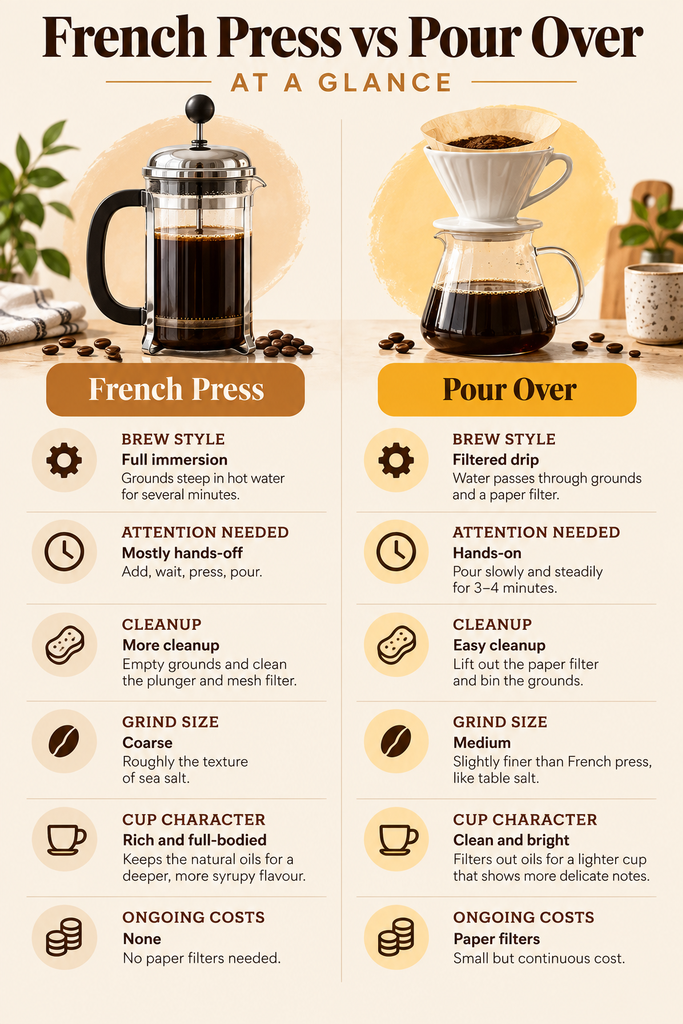
Neither method is doing it “wrong”. They’re just extracting differently, and that single mechanical difference is the root of almost every other difference on this list.
⏱️ Time Cost: Which Fits Your Actual Morning
French press is close to hands-off. Add grounds, pour water, wait roughly four minutes, press, pour. There’s no technique to get wrong beyond timing, and you can be doing something else in your kitchen while it steeps.
Pour over asks more of you while it’s happening. You’re pouring in slow, controlled circles to keep the water level and saturation even, which takes your full attention for three to four minutes rather than four minutes you can walk away from.
If your mornings are rushed, French press gives you your coffee back sooner with less babysitting. If your morning coffee is a bit of a ritual you actually enjoy, pour over rewards the attention rather than punishing it.
🧽 Cleanup and Daily Maintenance
French press cleanup means tipping out wet grounds, then properly cleaning the plunger and mesh filter, which trap oils and fine grounds that build up if you get lazy about it. Left rinsed but not washed a few days running, it starts smelling stale.
Pour over cleanup is usually just lifting out a paper filter full of grounds and binning it. The dripper itself rarely needs more than an occasional rinse, since the filter is doing the dirty work for you.
If you resent washing up first thing, that difference matters more than any flavour argument. Pour over is the lower-maintenance habit to sustain daily, even though it’s the higher-maintenance brew to make.
💷 Entry Cost and Ongoing Costs
A decent French press is a one-off purchase, typically landing somewhere in the £15 to £35 range for something that’ll last years, and there’s no ongoing filter cost since the mesh is reusable indefinitely.
Pour over needs a dripper and, ideally, a gooseneck kettle for proper control over your pour, which is where the entry cost can climb if you don’t already own one. We’ve covered gooseneck kettles properly in our gooseneck kettle buying guide if you want an actual buying steer rather than a rough estimate. On top of the initial kit, you’re buying paper filters continuously, which is a small but real ongoing cost French press simply doesn’t have.
If you’re testing the water on whether pour over suits you, it’s worth starting cheap on the dripper itself. If you already know it’s for you and just want the hardware sorted, our automatic pour-over coffee maker buying guide does the actual model-by-model comparison so this post doesn’t have to.
👅 Flavour and Mouthfeel: What You’ll Actually Notice
French press coffee has weight. The oils that pour over filters out stay in the cup, giving you a fuller, rounder mouthfeel and a flavour that leans towards deep and syrupy rather than bright.
Pour over is where you’ll actually taste the difference between coffee origins. Without the oils muddying things, the more delicate, brighter notes in a lighter roast come through clearly, which is why pour over is usually the method coffee people reach for when they want to actually taste a specific bean rather than just drink coffee.
Neither is more “correct”. If you like your coffee rich and full-bodied, French press will always taste more like what you want. If you like picking out individual notes, pour over will show you things French press quietly hides.
☕ How Each Actually Works, Step by Step
French press, in practice:
- Coarsely grind your beans, roughly the texture of sea salt.
- Add grounds to the empty press, then pour water just off the boil over the top.
- Give it a quick stir, pop the lid on with the plunger pulled up, and leave it for four minutes.
- Press down slowly and evenly, then pour immediately so the coffee doesn’t keep steeping.
Pour over, in practice:
- Grind to a medium consistency, finer than French press but coarser than espresso.
- Rinse your paper filter with hot water first, both to warm the dripper and remove any papery taste.
- Add grounds, then pour a small amount of water over them and let it sit for 30 seconds. This is the “bloom”, and it lets trapped gas escape so the rest of your pour extracts evenly.
- Continue pouring in slow, controlled circles over three to four minutes, keeping the water level fairly consistent until you’ve used all your water.
Written this way, French press has one moment where technique matters (how quickly you press), while pour over has several (the bloom, pour speed, and pour pattern). That’s really the whole story of why one feels more forgiving than the other.
⚖️ A Quick Grind Note
Grind size matters for both methods, but they need opposite ends of the scale. French press wants a coarse grind so grounds don’t slip through the mesh filter, while pour over wants something closer to medium so water doesn’t rush through too fast or pool on top. If you’re buying a grinder specifically with French press in mind, our French press grinder guide covers that in more depth than this post needs to.
🧭 A Simple Way to Decide
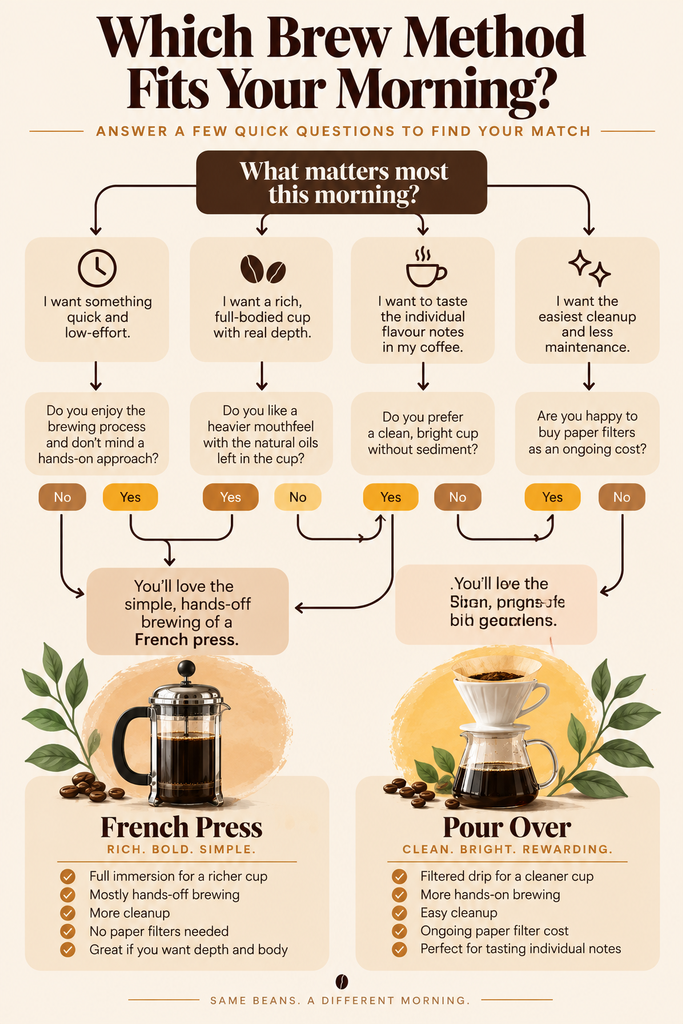
If most of these sound like you, French press is your method:
- You want coffee ready in under five minutes with minimal attention
- You don’t mind (or actively like) a fuller-bodied, heavier cup
- You’d rather clean a plunger occasionally than buy filters forever
- You’re not fussed about tasting subtle differences between beans
If most of these sound like you, pour over is worth the extra effort:
- You enjoy the process of making coffee, not just drinking it
- You want a cleaner, brighter cup and care about tasting specific beans
- You don’t mind buying filters and a gooseneck kettle
- Five minutes of focused pouring doesn’t feel like a chore before 8am
Plenty of people end up owning both and reaching for whichever suits that particular morning. That’s not indecision, it’s just using the right tool for how you actually feel that day.
🛒 Already Own Neither? Start Here
If you’re choosing your very first brew method rather than adding a second one, French press is the easier on-ramp. It’s cheaper to buy, harder to get wrong, and teaches you what good coffee can taste like before you start worrying about pour technique.
Pour over is a brilliant second method once you already know you enjoy making coffee, not just drinking it, and want to get more particular about the beans you’re using. There’s no rule that says you have to pick one forever, plenty of coffee enthusiasts keep both on the counter and choose depending on the morning.
❓ FAQs
Which is easier for a total beginner? French press. There’s no pouring technique to learn, no risk of channelling water through the grounds unevenly, and the four-minute steep forgives small timing mistakes far more than pour over forgives an uneven pour.
Does pour over really taste that different? Yes, more than most beginners expect. The paper filter removes oils and fine sediment that French press lets through, so you’re tasting a noticeably cleaner, lighter cup rather than a subtly different version of the same coffee.
Do I need a gooseneck kettle for pour over? Not strictly, but it makes a real difference. A regular kettle pours in an uncontrolled rush, while a gooseneck gives you the slow, steady stream pour over technique actually depends on.
Can I use the same beans for both methods? You can, but you may prefer different roasts for each. French press flatters darker, fuller roasts because the extra body works with that character, while pour over tends to suit lighter roasts where you want the brighter, more delicate notes to come through.
Both methods make good coffee. The honest answer to “which is better” is whichever one you’ll actually still be using in six months, not whichever one wins on paper.