If you’ve been eyeing up an espresso machine for months but keep closing the tab because every “best of” list seems to be written for someone in Ohio, you’re not alone. Most buying guides quote dollar prices, recommend machines you can’t get delivered to a UK address, and skip the one thing that actually decides whether you’ll use the thing daily: fit for your kitchen, your coffee habits, and your patience for faff.
As an Amazon Associate, I earn from qualifying purchases and sometimes recommend products from other sellers at no extra cost to you. For more details see my disclosure policy and privacy policy.
This guide sticks to machines you can genuinely buy in the UK right now, priced in pounds, sorted by what you’ll actually spend rather than an arbitrary “best overall” pick that ignores budget entirely.
☕ Start With Your Budget, Not the Machine
Before you fall for a machine because of its looks, decide roughly what you want to spend. Espresso machines split fairly cleanly into three UK price bands, and each band suits a different kind of buyer.

The Coffee Chef Planner
Daily planning, journalling, and a proper coffee tasting log with a flavour wheel — 20 pages in one printable bundle.
Shop the planner →
Brewforge
A growing edit of coffee bar gear we’d genuinely want on our own counter, added to as we find things worth having.
Shop Brewforge →Budget machines (roughly £150-£300) get you genuine espresso, not instant-coffee-with-extra-steps, but expect a manual steam wand and a shorter feature list. Mid-range machines (£300-£600) add consistency, better steam performance, and often a few beginner-friendly extras. Prosumer machines (£600+) are for people who already know they love making coffee and want the control, or the built-in grinder, to match.
If you already own a coffee machine such as The Coffee Chef’s Best Coffee Machines for Home UK guide covers, and you’re upgrading specifically to espresso, this budget-first approach is worth following closely: it’s easy to overspend on features you won’t use in year one.
💰 Budget Picks (£150-£300): Real Espresso Without the Splurge
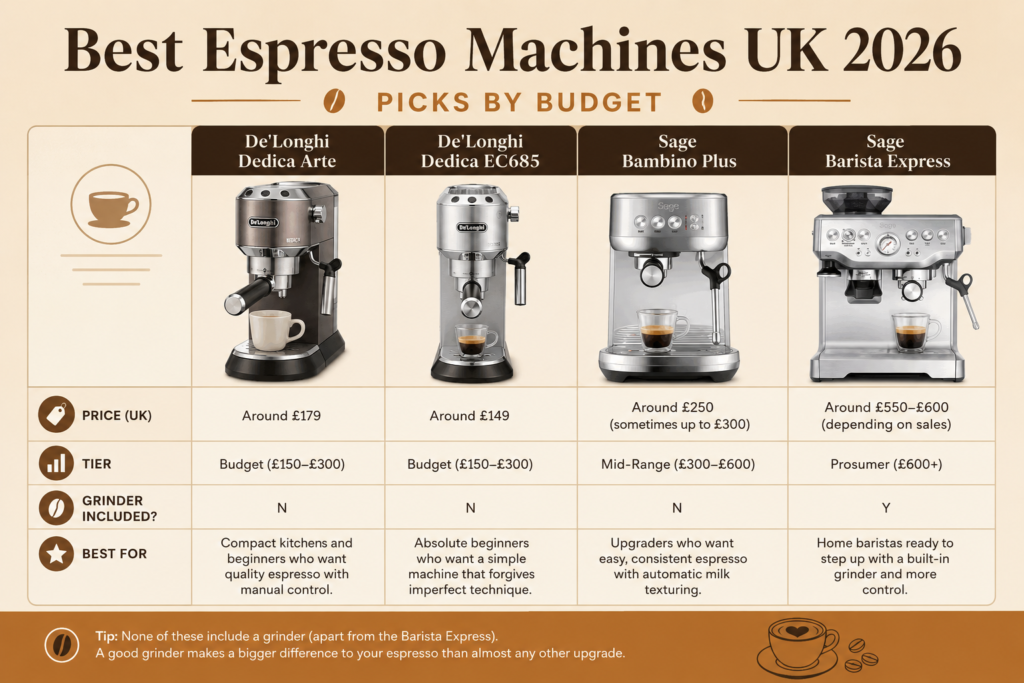
The De’Longhi Dedica Arte (around £179) is the standout in this bracket. At just 15cm wide it fits on the narrowest UK kitchen worktop, and its 15-bar pump delivers proper espresso rather than the watery approximation you get from cheaper capsule machines. The three-in-one filter system takes ground coffee, ESE pods, or De’Longhi’s own capsules, so it’s flexible while you’re still working out what you like.
Heat-up time is around 35 seconds thanks to the Thermoblock system. The manual steam wand, while it takes a bit of practice, produces genuinely frothed milk rather than the froth-adjacent foam some entry machines manage.
If you want to go even leaner, the De’Longhi Dedica EC685 (around £149) strips things back further with dual-wall pressurised baskets that forgive an imprecise grind, which is handy while you’re learning.
Neither of these machines includes a grinder, so budget for that separately (more on this below) unless you’re happy using pre-ground coffee, which will cap how good your espresso can get.
⚖️ Mid-Range Machines (£300-£600): Where Most UK Buyers Should Actually Land
For most people upgrading from a pod machine or a cafetière, the Sage Bambino Plus (around £250, sometimes creeping toward the £300 mark depending on retailer) is the machine we’d point you towards first. It’s a semi-automatic machine with automatic milk texturing, which takes the trickiest part of espresso-making, the steaming, largely out of your hands while you build confidence with everything else. It heats in three seconds and holds temperature well, which matters more than it sounds for consistent shots.
This tier is also where you start seeing genuinely reliable results without needing barista training. If manual steam wands sound like a hard pass, this is your band.
🏆 Prosumer Picks (£600+): For the Serious Home Barista
The Sage Barista Express (around £550-£600 depending on sales) sits right at the top of this guide’s range and earns its place because it solves the grinder problem outright: it has one built in. That’s a genuinely big deal for a beginner-turned-hobbyist, because dialling in a separate grinder is where most people either give up or overspend. The dose calibration tools are forgiving of early mistakes, and there’s a pressurised basket option so you can start with pre-ground coffee and switch to fresh-ground once you’re ready.
If you’re the kind of person who already reads about coffee origins for fun (our Central American Coffee regional guide is a good rabbit hole), this is the tier where your machine can actually keep up with your curiosity.
🔧 Automatic vs Semi-Automatic: Which Suits You?
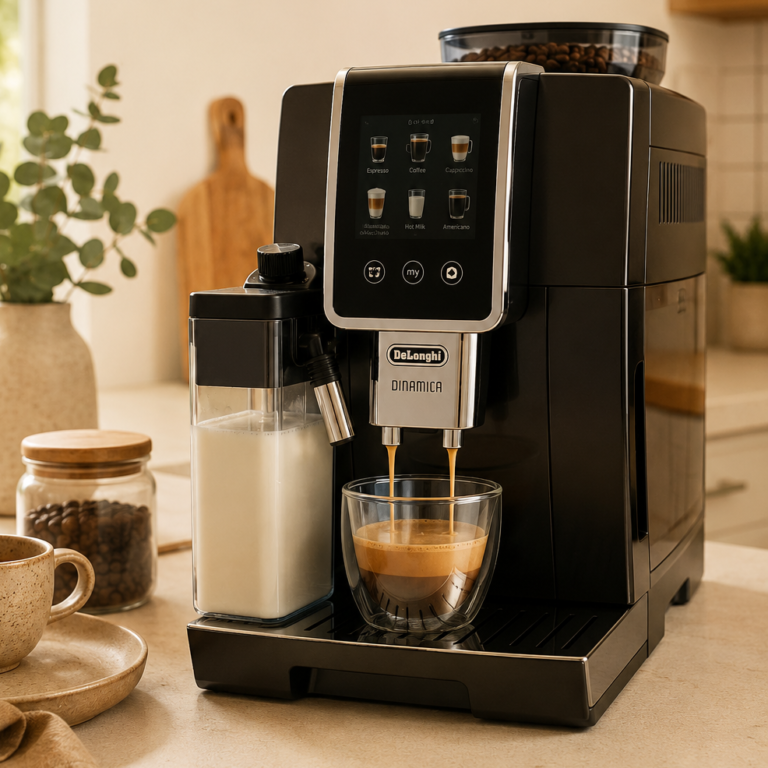
This is the distinction that trips up the most UK buyers, so it’s worth being blunt about it. Fully automatic (bean-to-cup) machines grind, tamp, and pull the shot at the press of one button, and they’re brilliant if you want your coffee with zero ritual. Semi-automatic machines, which is what every pick above actually is, put you in charge of grind size, dose, and often milk texturing, in exchange for noticeably better and more customisable espresso.
None of the machines in this guide are true bean-to-cup automatics. If that’s genuinely what you want, that’s a different buying guide and a different budget bracket entirely, since decent bean-to-cup machines tend to start well above £400.
⚙️ Grinder-Included or Separate? The UK Buyer’s Most Common Mixup
Here’s the bit that catches people out after they’ve already bought the machine: only the Sage Barista Express above has a grinder built in. Every other pick needs a separate burr grinder to hit its full potential, and skipping this step is the single biggest reason people end up disappointed with an otherwise good espresso machine.
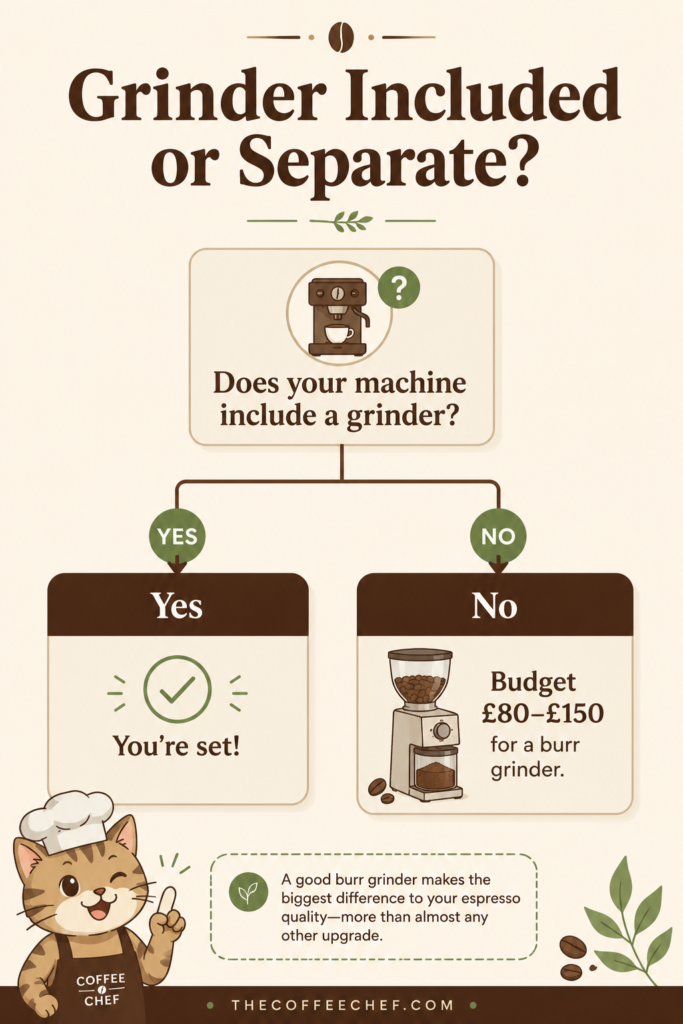
Budget at least £80-£150 for a decent entry-level burr grinder. The Baratza Encore ESP (roughly £140-£160) is a strong choice specifically for espresso, since its burrs are built for the fine, consistent grind espresso demands rather than general filter coffee. If our single dose grinder roundup is more your speed for a leaner kitchen setup, that’s worth a look too, though it’s aimed at a slightly different use case.
Blade grinders will not get you there. They chop unevenly rather than grind, and uneven grounds mean uneven extraction, which is the fastest way to make a £250 machine taste like a £50 one.
🇬🇧 UK-Specific Buying Factors That US Guides Skip
A few things matter specifically because you’re buying in the UK, not the US:
- Plug type and voltage: every machine listed here ships with a UK three-pin plug and is rated for UK mains voltage, so you won’t run into the step-down transformer issues that plague imported US models.
- Warranty and support: De’Longhi and Sage both run proper UK-based warranty and repair support, which matters more than it seems the first time a seal needs replacing.
- Where to actually buy: John Lewis and Currys both stock these ranges with UK-standard two-year warranties as a baseline, and Amazon UK is reliable for De’Longhi and Sage stock specifically (steer clear of third-party sellers shipping from outside the UK, since warranty support gets murky). Specialist roasters and coffee equipment shops are worth checking too, particularly for the Sage range, as they’ll sometimes bundle beans or grinders at a better combined price.
💧 Descaling and Maintenance in UK Hard Water Areas
If you live anywhere from London through the Home Counties, the Midlands, or much of the South East, you’re almost certainly in a hard water area, and your espresso machine will scale up faster than the manual suggests. Limescale doesn’t just affect taste, it clogs the internal boiler and can shorten the machine’s working life significantly.
Descale every four to six weeks in hard water areas rather than waiting for the machine’s built-in reminder, which is usually calibrated for average UK water hardness rather than the harder end of the scale. A citric acid-based descaler works fine for all the machines above; just check the manufacturer’s specific instructions before your first descale, since cycle length and dilution ratios vary between brands.
📊 How These Picks Compare at a Glance
- De’Longhi Dedica Arte (~£179): Budget tier, manual steam wand, no grinder included, best for testing whether espresso-at-home is for you.
- De’Longhi Dedica EC685 (~£149): Leaner budget option, dual-wall baskets forgive an imprecise grind, same narrow 15cm footprint.
- Sage Bambino Plus (~£250-£300): Mid-range, automatic milk texturing, three-second heat-up, best all-rounder for most UK buyers.
- Sage Barista Express (~£550-£600): Prosumer, built-in grinder, calibrated dosing tools, best if you already know this is a long-term hobby.
- Baratza Encore ESP grinder (~£140-£160): Pair with any of the above except the Barista Express, since fine, even grinding is where cheap espresso setups usually fall down.
🙋 Quick Answers to Common Questions
Do I need a separate grinder? Yes, unless you’ve bought the Sage Barista Express. Pre-ground coffee staling within days of opening is the single biggest reason home espresso disappoints.
Can I use any beans? Technically yes, but look for bags labelled specifically for espresso, since the roast profile is developed for the shorter, more pressurised brew time. A filter-roast bean can taste thin or sour pulled as espresso.
Is bean-to-cup better? Not necessarily better, just different. Bean-to-cup machines trade control and flavour ceiling for convenience, and tend to sit above £400 for anything decent, so they’re a separate buying decision from the semi-automatic machines covered here.
🎯 The Quick Answer
If you read nothing else: the De’Longhi Dedica Arte is the sensible starting point if you’re testing the water, the Sage Bambino Plus is where most people should actually land for the best balance of ease and quality, and the Sage Barista Express is worth the extra spend the moment you know you’re in this for the long haul, purely because it solves the grinder problem for you.
Whichever tier you land in, budget for a proper grinder unless you’ve bought the Barista Express, and get your first descale booked into the calendar before the machine even arrives. Future you, dealing with a scaled-up boiler eighteen months from now, will be grateful.