You’ve ordered a latte a hundred times without thinking twice, then a friend orders a flat white and you’re suddenly not sure what separates it from your usual. It’s not really about size, and it’s not really about strength either. The real difference sits in how the milk is treated, and once you know that, ordering with confidence gets a lot easier.
As an Amazon Associate, I earn from qualifying purchases and sometimes recommend products from other sellers at no extra cost to you. For more details see my disclosure policy and privacy policy.
🥛 It’s All About the Milk, Not the Size
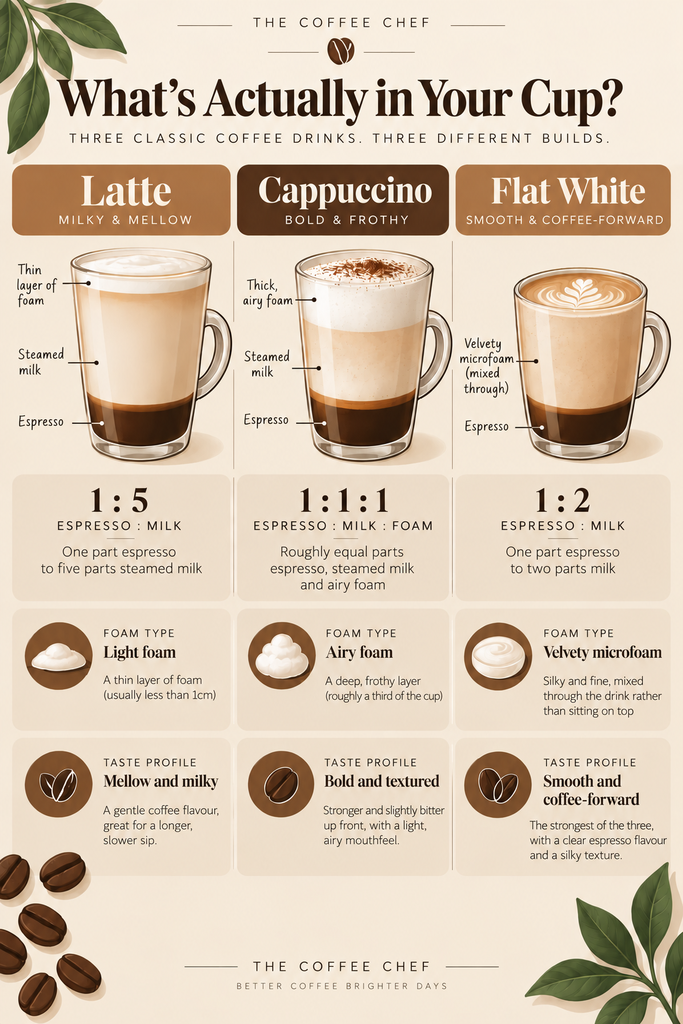
Most people assume a latte, a cappuccino and a flat white are just different sizes of the same drink. They’re not. Each one uses a different ratio of espresso to steamed milk, and a different thickness of foam on top, and that’s what actually changes what lands in your cup.
A latte is built on roughly one part espresso to five parts steamed milk, finished with a thin layer of foam, usually less than a centimetre deep. A cappuccino uses a much richer ratio, close to equal parts espresso, steamed milk and airy foam, which is why it’s the frothiest of the three. A flat white sits in between on milk volume, at around one part espresso to two parts milk, but the milk itself is textured completely differently: instead of foam sitting on top, it’s velvety microfoam folded through the whole drink.

The Coffee Chef Planner
Daily planning, journalling, and a proper coffee tasting log with a flavour wheel — 20 pages in one printable bundle.
Shop the planner →
Brewforge
A growing edit of coffee bar gear we’d genuinely want on our own counter, added to as we find things worth having.
Shop Brewforge →That microfoam is the real signature of a flat white. It’s steamed to be silky and fine rather than airy, so the espresso flavour comes through more clearly even though there’s more milk in the cup than in a cappuccino.
Quick reference:
| Drink | Espresso : Milk | Foam type | Foam depth |
|---|---|---|---|
| Latte | 1 : 5 | Light foam | Thin, under 1cm |
| Cappuccino | 1 : 1 : 1 (espresso, milk, foam) | Airy foam | Deep, roughly a third of the cup |
| Flat white | 1 : 2 | Velvety microfoam | Mixed through, no separate layer |
🌍 Where Each Drink Actually Comes From
The latte has its roots in Italy, where caffè latte simply means “milk coffee.” The version most people order in the UK today, tall, mild and made for sipping slowly, actually owes more to how American coffee shops popularised the drink through the 1980s and 90s than to how it’s traditionally taken in Italy.
Cappuccino is properly Italian and properly old, dating back to early 20th-century Italy. It’s named for the colour of Capuchin friars’ robes, which the milky-brown drink was thought to resemble. Traditionally it’s a small, strong, breakfast-only order; you won’t see many Italians drinking one after midday.
The flat white has a far more recent, and more contested, history. Both Australia and New Zealand claim to have invented it in the 1980s, as a reaction against overly frothy, milk-heavy lattes. It was designed for people who wanted a proper hit of espresso without losing the smoothness that milk brings.
👅 Taste and Texture: What You’ll Actually Notice in the Cup
- Latte: mellow, milky and gentle on the espresso, a good option if you find straight espresso too intense.
- Cappuccino: bold and slightly bitter up front, followed by a light, airy mouthful of foam. Great if you enjoy texture as much as flavour.
- Flat white: the strongest-tasting of the three despite its modest milk volume, since there’s no thick foam layer diluting the sip. Smooth and distinctly coffee-forward.
Foam depth does most of the work here. A deep foam layer sits on top and separates from the coffee as you drink, so a cappuccino genuinely tastes different at the top of the cup than at the bottom. A flat white doesn’t have that problem, because the microfoam is mixed all the way through rather than piled on top.
🏪 Ordering with Confidence at a UK Café
Cup sizes and naming aren’t consistent across UK chains, which is usually where people start second-guessing themselves.
At Costa and Caffè Nero, you’ll typically find all three as standard menu items, with the flat white served in a noticeably smaller cup than a latte. That’s deliberate, not a size downgrade; most independents cap a flat white around 160-200ml, since a bigger flat white starts to lose the point of the drink. Ordering a “large flat white” is a bit of a contradiction for that reason.
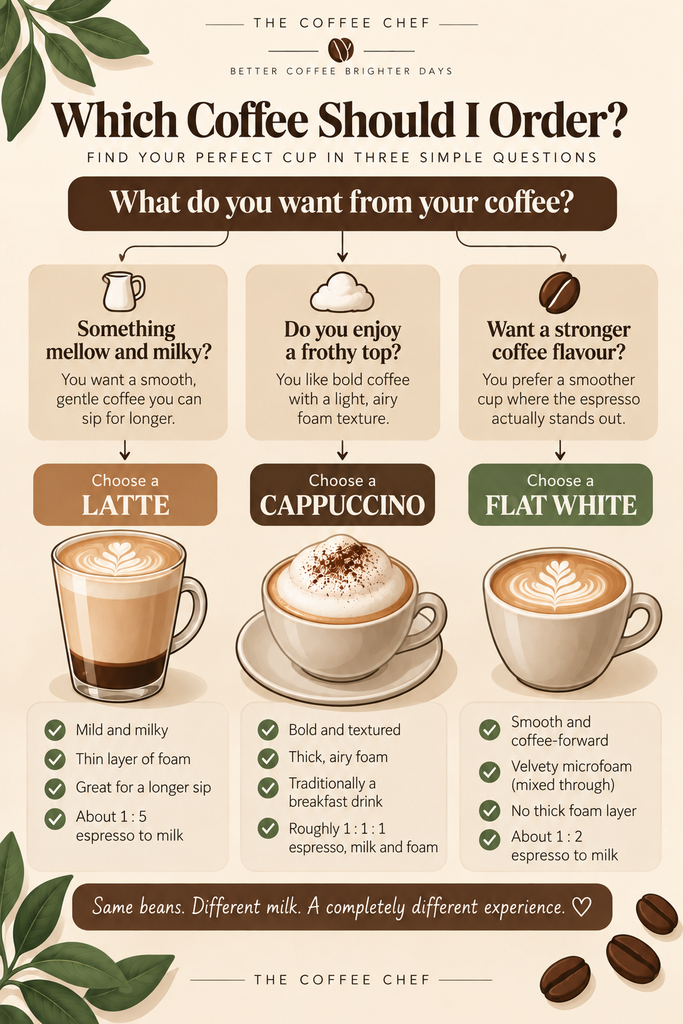
If you’re stood at the counter unsure, here’s the quick version:
- Want something mellow and milky you can sip for twenty minutes? Order a latte.
- Want a proper caffeine hit with a frothy top? Order a cappuccino.
- Want your espresso to actually taste like something, in a smaller, smoother cup? Order a flat white.
Independent coffee shops tend to be more consistent with flat whites specifically, since it’s closely associated with specialty coffee culture, so baristas there generally take extra care with it.
🏠 Making Your Own at Home
You don’t need a full barista setup to get a decent approximation of any of these.
For a home latte or flat white, what matters most is texturing your milk properly rather than simply heating it. Frothing Milk for Coffee: Tips, Tricks and Ideas walks through how to do this with a jug and a handheld frother if you don’t have a steam wand, and it’s the single biggest upgrade you can make to home coffee without buying new equipment.
The milk itself matters more than people expect, too. Whole dairy milk froths best because of its fat content, but if you’re using an alternative, look for one labelled “barista,” like Oatly Barista Edition, which is formulated specifically to hold microfoam rather than separate the way standard oat milk can. Our milk alternatives buyer’s guide breaks down which ones actually steam well if dairy’s not for you.
If you want to go beyond instant or pod coffee altogether, an entry-level machine with a built-in steam wand, such as the Sage Bambino Plus, gives you a proper espresso shot and the ability to texture milk properly, which covers all three drinks from one machine.
❓ Quick Questions People Actually Ask
Is a flat white just a small latte? No. It’s a genuine style distinction, not a size call. The milk is steamed differently (fine microfoam rather than foam sitting on top), and the espresso-to-milk ratio is different too, which is why a flat white tastes noticeably stronger than a latte even in a similar-sized cup.
Which has more caffeine, a latte or a cappuccino? Neither. Both are built on the same base of espresso shots (usually a double), so the caffeine content is essentially identical. What changes is how diluted that espresso tastes once the milk and foam are added.
Can I order a flat white anywhere in the UK? Nearly always at the major chains and any half-decent independent, but smaller cafés and greasy-spoon-style places may only offer latte and cappuccino, since the flat white is a more recent addition to the mainstream UK menu.
🤔 Which One Should You Actually Order?
- Strong and straightforward: flat white.
- Milky and mellow: latte.
- Frothy and bold: cappuccino.
Next time you’re at the counter, remember the real question isn’t about cup size. It’s how much milk you want, and how it’s been treated. Order accordingly, and you’ll get exactly what you’re after every time. For a related order to have down pat, our Caramel Macchiato vs Caramel Latte breakdown untangles another pair that gets mixed up just as often.