Every great cup starts with a question most drinkers never ask: where did these beans actually come from? Coffee grows in a narrow band around the equator known as the Bean Belt, and the exact patch of soil, altitude and climate a bean comes from shapes everything about how it tastes, long before a roaster ever gets near it.
As an Amazon Associate, I earn from qualifying purchases and sometimes recommend products from other sellers at no extra cost to you. For more details see my disclosure policy and privacy policy.
This guide walks through the world’s major coffee-growing regions, what makes each one distinctive, and what to look for the next time you’re choosing a bag of single-origin beans. Think of it as your map for buying with a bit more confidence, not an exhaustive encyclopaedia of every growing region on earth. We’ll cover East Africa, the Americas, Asia-Pacific, a couple of rare specialist origins, why processing method matters just as much as geography, and how to actually put all of this into practice next time you’re stood in front of a shelf of unfamiliar bags.
🗺️ Why Origin Actually Changes the Flavour in Your Cup
Before diving region by region, it helps to understand why origin matters at all. Three things do most of the work: altitude, soil, and climate.

The Coffee Chef Planner
Daily planning, journalling, and a proper coffee tasting log with a flavour wheel — 20 pages in one printable bundle.
Shop the planner →
Brewforge
A growing edit of coffee bar gear we’d genuinely want on our own counter, added to as we find things worth having.
Shop Brewforge →Higher altitude generally means the coffee cherry ripens more slowly, which gives the bean more time to develop sugars and complex flavour compounds. This is a big part of why so many of the world’s most prized coffees, from Ethiopian highlands to Guatemalan volcanic slopes, are grown well above 1,200 metres.
Soil matters too. Volcanic soil in particular tends to be mineral-rich, which is why you’ll see “volcanic” pop up again and again in tasting notes for countries like Guatemala and Costa Rica. It’s not just marketing language, it genuinely correlates with a brighter, more mineral edge in the cup.
Climate, and specifically rainfall patterns, dictates the growing and harvest calendar, which in turn affects everything from cherry ripeness at picking to how the beans can be processed afterwards. A region with a clearly defined dry season, for instance, has an easier time with sun-drying beans for natural processing than one with unpredictable rain.
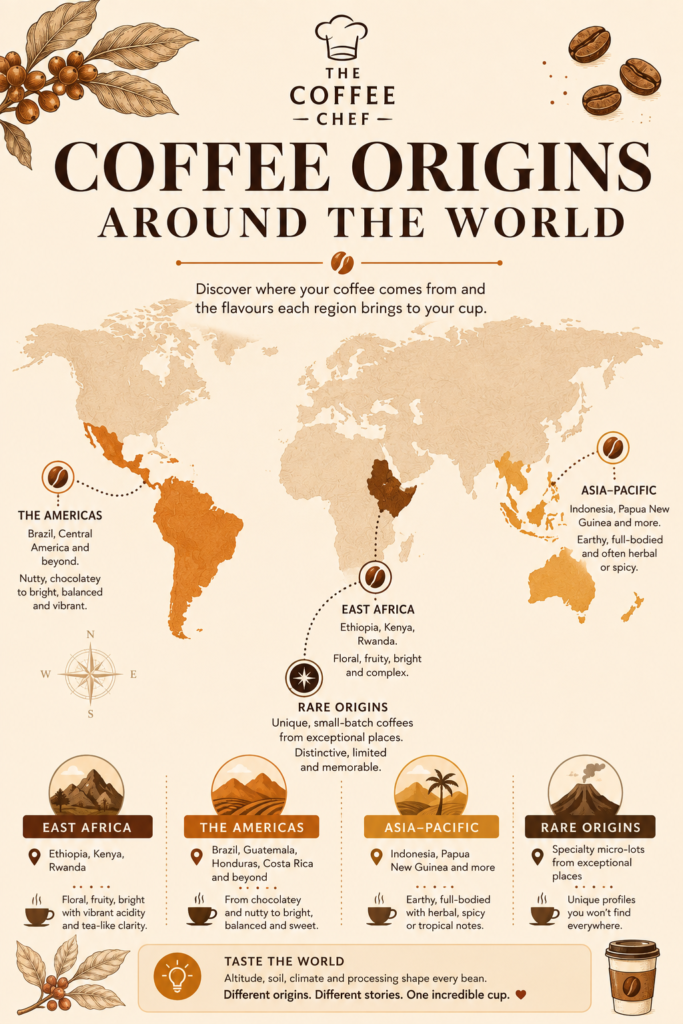
🌍 East Africa: Where Arabica Began
East Africa is where the arabica coffee plant is believed to have originated, and the region still produces some of the most distinctive, sought-after beans available anywhere.
Ethiopia is the standard-bearer. Many Ethiopian farms still grow heirloom varieties that predate the naming conventions used elsewhere in the coffee world, since so much genetic diversity in arabica traces back to this one country. The cup profile typically leans floral and fruity, sometimes almost like berries, stone fruit or jasmine tea, depending on the specific growing area and processing method. If you want to understand what specialty coffee people mean when they talk about a coffee being “bright” or “complex,” an Ethiopian single origin is one of the best places to start tasting your way into that vocabulary.
Kenya brings something quite different to the table: bold acidity, distinctive blackcurrant notes, and a grading system (AA being the largest bean size, though size alone doesn’t guarantee the best cup) that’s become a shorthand for quality among roasters worldwide. Kenyan coffee tends to be processed using a distinctive double-fermentation washing method that many specialty drinkers credit for its clarity and intensity. Our complete guide to Kenyan coffee goes much deeper into what makes these beans so distinctive if you want to explore further.
Rwanda is worth watching too. It’s a considerably smaller producer than its neighbours, but it has built a genuine reputation in the specialty scene over the past decade or so, particularly for washed lots that show clean, tea-like clarity with a gentler acidity than Kenya. As the country’s coffee infrastructure has matured, more Rwandan lots have started appearing on UK specialty shelves, often at a more approachable price point than Ethiopian or Kenyan equivalents.
🌎 The Americas: Brazil, Central America and Beyond
Brazil is the world’s largest coffee producer by volume, by some distance, and its beans tend to be nutty and chocolatey with low acidity, largely thanks to the natural (dry) processing method used on much of the crop and the country’s relatively lower average growing altitude compared to East Africa. It’s a reliable, comforting cup rather than a showy one, which is exactly why it forms the backbone of so many espresso blends: it adds body and sweetness without fighting for attention.
Guatemala offers something more dramatic. Volcanic soil across growing regions like Antigua and Huehuetenango gives the beans a distinctive minerality alongside chocolate and warm spice notes, and the country’s varied altitude across different growing zones means there’s real range within Guatemalan coffee itself, not just compared to its neighbours.
Beyond Brazil and Guatemala, Honduras and Costa Rica share broadly similar growing conditions across Central America (high altitude, volcanic soil, and a clear wet and dry season split that suits careful, deliberate processing) while each bringing its own flavour range to the table. Costa Rica tends toward clean, bright, well-balanced cups thanks to strict quality control standards enforced at a national level, while Honduras has quietly built an increasingly well-regarded specialty scene, with more micro-lot producers gaining recognition each year. If you want the fuller picture of how these shared growing conditions translate into flavour differences, our Central American coffee regional guide covers the brewing side of things too.
Colombia and Peru round out the Americas as two of the most widely available single-origin options on UK shelves, prized for their consistency and approachable, well-balanced cups that tend to sit comfortably between Brazil’s mellow simplicity and the brighter acidity of East African coffees. Colombia in particular benefits from a huge range of microclimates across its mountain regions, which is why you’ll often see Colombian beans sold by specific department (Huila and Nariño being two names worth learning) rather than just “Colombia” as a blanket label.
🌏 Asia-Pacific: Earthy, Bold and Distinctive
Sumatra, in Indonesia, is the region’s headline act. It’s typically wet-hulled, a processing method largely unique to this part of the world where the parchment layer is removed from the bean while it’s still relatively wet, which produces a low-acid, earthy, almost syrupy cup with herbal or woody undertones that’s instantly recognisable once you’ve tried it. It’s a genuinely divisive style, drinkers tend to either love it or find it too heavy, which makes it a good one to try in a small bag before committing to more.
For readers who want to go further afield, India’s Monsooned Malabar is a genuine curiosity worth knowing about: beans are deliberately exposed to monsoon winds and humidity for weeks at a time, a process that mellows the acidity dramatically and produces a smooth, low-acid cup with a distinctive golden colour to the raw bean itself. Papua New Guinea is also worth a mention, producing washed coffees with a clean, fruity profile that sits somewhere between African brightness and Central American balance, thanks to volcanic soil and high growing altitudes similar to those found in East Africa.
💎 Rare and Specialty Origins Worth a Splurge
A couple of origins sit firmly in specialist or occasional-treat territory, both for their scarcity and, frankly, for their price.
Yemen is one of the oldest coffee origins in the world, farmed on ancient stone terraces using techniques that have barely changed in centuries, with small-lot, often unpredictable yields due to the country’s harsh growing conditions and limited water access. It’s historic, distinctive, often intensely fruity and wine-like, and not something you’ll find on a supermarket shelf. Expect to pay a premium if you do track down a bag from a specialist roaster.
Panama is famous in specialty circles for the Geisha (or Gesha) variety, a coffee plant originally from Ethiopia that found its true expression when planted at high altitude in Panama’s Boquete region. It regularly commands eye-watering prices at competitive auction thanks to its intensely floral, almost tea-like character, unlike almost anything else in the coffee world. If you ever see a Panama Geisha on a specialist roaster’s menu, it’s genuinely worth trying at least once, even if that means splitting a small bag with a coffee-loving friend.
🔬 Processing Matters as Much as Origin
Where a coffee is grown only tells half the story. How the cherry is processed after picking has just as much influence on the final flavour, and it’s worth understanding the three main methods before you next buy a bag.
- Washed (wet) process: The fruit is removed from the bean before drying, usually via fermentation tanks followed by a thorough wash, producing a cleaner, brighter, more acidic cup that lets the origin’s natural characteristics shine through clearly. This is the standard for much of East Africa and large parts of Central America.
- Natural (dry) process: The whole cherry is dried around the bean, often on raised beds in the sun, letting fermentation happen inside the intact fruit over several weeks. This gives a heavier body and often boozy, fruity, sometimes almost fermented notes, and it’s common in Brazil and much of Ethiopia.
- Honey process: A middle ground where some or all of the sticky fruit mucilage is left on the bean during drying, using significantly less water than a full wash since it skips the fermentation tanks entirely. It tends to add sweetness and body while keeping much of the clarity you’d expect from a washed coffee, making it a genuinely useful bridge style if you like the idea of natural processing but aren’t sure about the boldness.
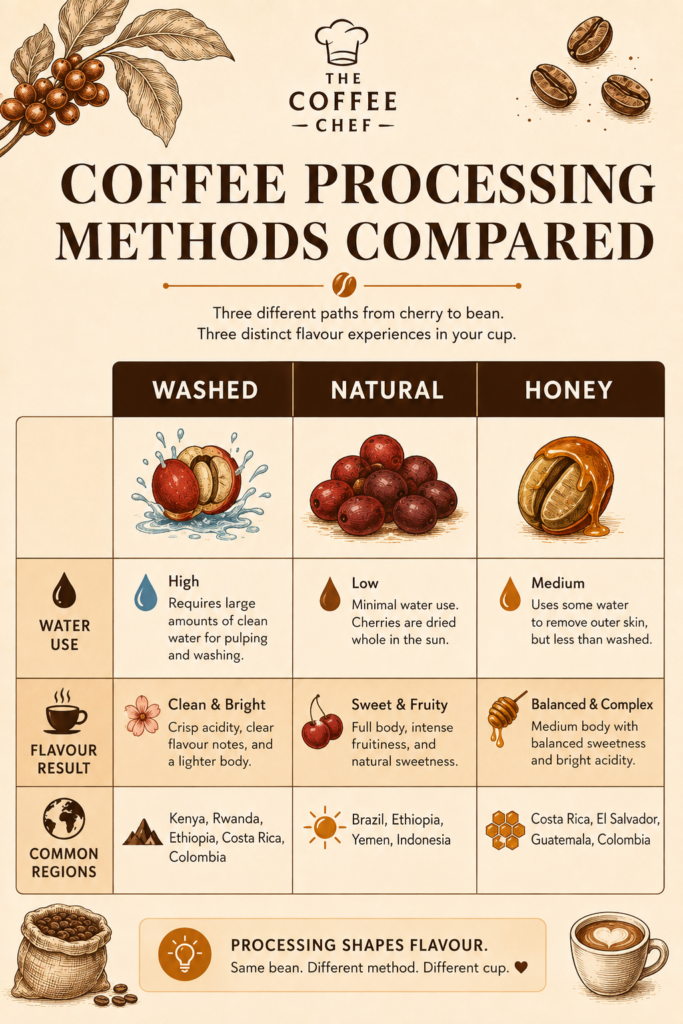
Knowing the processing method on a bag tells you almost as much as the origin itself, so it’s worth checking both before you buy, and worth asking your roaster directly if it isn’t printed on the label.
☕ How to Taste and Compare Origins at Home
If you want to actually train your palate rather than just take our word for any of this, the easiest way is a simple side-by-side cupping at home. Brew two different origins using the same method and roughly the same water-to-coffee ratio, then taste them one after the other.
Pay attention to acidity first (does it feel bright and lively, or gentle and rounded), then body (light and tea-like, or heavy and syrupy), then whatever flavour notes jump out once the coffee has cooled slightly, since flavour often becomes clearer as the temperature drops. Comparing an East African washed coffee against a Brazilian natural is a genuinely eye-opening first experiment, since the two sit at almost opposite ends of the flavour spectrum covered in this guide.
The Coffee Chef
Which coffee origin matches your taste?
5 quick questions, one bag of beans to try next.
Question 1 of 5
What’s your ideal coffee flavour?
Question 2 of 5
Pick a breakfast.
Question 3 of 5
Pick your ideal coffee shop vibe.
Question 4 of 5
How adventurous are you with new flavours generally?
Question 5 of 5
Pick a weekend plan.
Your match
📋 Origins at a Glance
If you’d rather skim than read the full regional breakdown again, here’s a quick reference for the origins covered above and what to expect from each one:
- Ethiopia: Floral, fruity, sometimes berry-like. A great introduction to what “bright” specialty coffee tastes like.
- Kenya: Bold acidity, blackcurrant notes, distinctive double-washed processing.
- Rwanda: Clean, tea-like clarity, gentler acidity than its East African neighbours.
- Brazil: Nutty, chocolatey, low acidity, reliable rather than showy.
- Guatemala: Volcanic minerality alongside chocolate and spice.
- Honduras and Costa Rica: Central American growing conditions, with Costa Rica leaning clean and balanced and Honduras building a growing specialty reputation.
- Colombia and Peru: Widely available, consistent, approachable middle ground.
- Sumatra: Earthy, low-acid, syrupy, wet-hulled and instantly recognisable.
- India (Monsooned Malabar): Smooth and low-acid thanks to deliberate monsoon exposure.
- Papua New Guinea: Clean, fruity, sitting between African and Central American styles.
- Yemen: Historic, small-lot, wine-like, genuinely rare.
- Panama (Geisha): Intensely floral, auction-prized, a genuine splurge.
Keep in mind this is a starting point rather than a complete list of every coffee-producing country. There’s a good argument for exploring plenty of origins we haven’t covered here in depth once you’ve worked through this list, since the coffee belt spans dozens of countries across Africa, the Americas and Asia-Pacific.
🎒 Building Your Own Tasting Journey
A nice way to use this guide practically is to treat it as a loose checklist rather than something to read once and forget. Pick one origin from each region (say, an Ethiopian, a Guatemalan and a Sumatran) and taste them over a few weeks using the same brew method each time.
Keep a simple note of what you tasted and whether you liked it, even just a couple of words in your phone notes app. Over time, you’ll start noticing patterns in what you actually prefer, whether that’s bright and floral East African coffees, heavier natural-processed cups, or the clean balance of Central and South America. That preference is honestly more useful for future buying decisions than memorising every regional fact in this guide.
🛒 Buying Single-Origin Coffee in the UK
You don’t need to import beans yourself to explore any of this. UK specialty roasters and coffee subscription services increasingly list origin, altitude, variety and processing method right on the bag, which makes it far easier to shop with intent rather than guesswork.
If you’re new to single-origin buying more generally, our guide to exploring the rich and unique flavours of single-origin coffee is a good next stop, and it pairs well with this regional overview once you’re ready to start choosing bags for yourself.
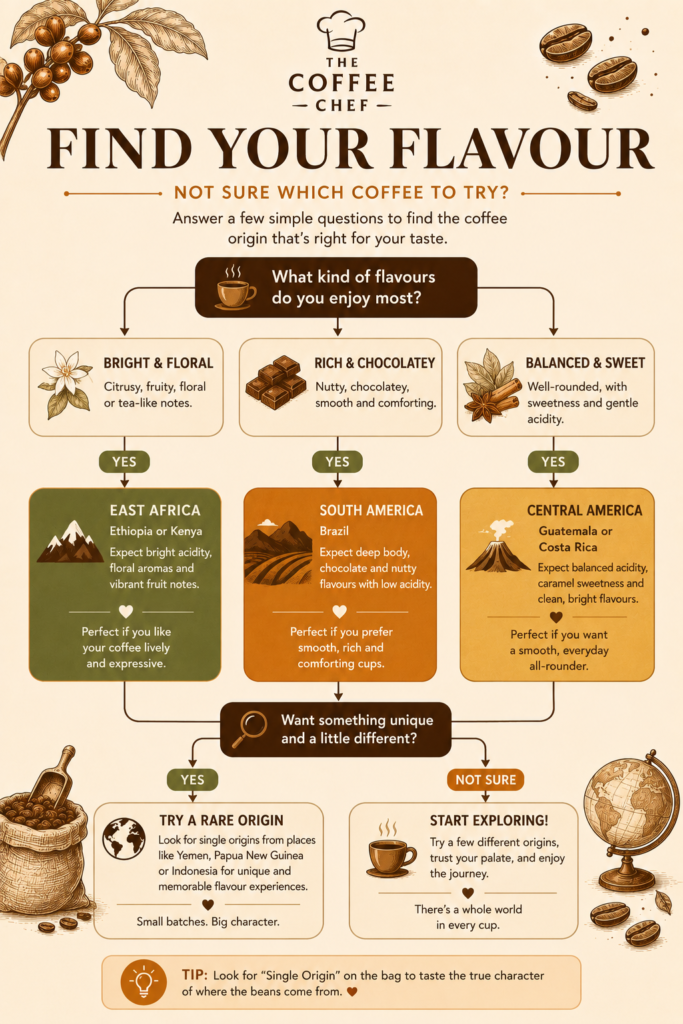
A few practical tips to take with you: buy from roasters who publish a roast date (not just a best-before date), start with something from a region you haven’t tried before rather than reaching for the familiar, and don’t be afraid to ask your roaster what processing method a bag used if it isn’t printed on the label. Most specialty roasters are genuinely happy to talk through it, and a good conversation with whoever sold you the bag is often worth more than any guide, including this one.
❓ FAQs
What’s the difference between arabica and robusta? Arabica is the higher-quality species most specialty coffee is made from, grown at higher altitudes and prized for its complexity and range of flavour. Robusta grows at lower altitudes, has roughly double the caffeine content, and tends to taste more bitter and one-dimensional on its own, though it’s increasingly used in high-quality espresso blends for the extra body and crema it contributes.
Is single-origin coffee always better than a blend? Not necessarily. Single-origin lets you taste a specific place and process in isolation, which is great for learning your preferences and building your palate, but a well-made blend can offer more consistency and balance, especially for espresso, where several origins working together often produces a rounder result than any one origin alone.
Does processing method matter more than origin? They work together rather than competing. The same origin can taste quite different depending on whether it’s washed, natural or honey-processed, so it’s worth treating both origin and processing as equally important when choosing a bag, rather than focusing on just one.
How do I know if a bag of coffee is genuinely single-origin? Look for a specific farm, cooperative or region named on the packaging, ideally alongside a processing method and altitude. Vague terms like “origin blend” or no origin information at all are red flags if you’re specifically shopping for single-origin coffee.
Why do some origins cost so much more than others? Price generally reflects scarcity, growing difficulty, and demand from specialty buyers. Origins like Panama Geisha or Yemeni coffee involve small, labour-intensive harvests in difficult growing conditions, while high-volume origins like Brazil benefit from economies of scale that keep prices more accessible.