Bottled syrups are fine, but they’re also a bit of a shortcut, and they all end up tasting faintly of the same vanilla-caramel sameness. The good news is that everything a syrup does, a bit of technique does better: real spice, real vanilla, real citrus oil, worked into your coffee at the right stage. Once you’ve tried a properly infused milk or a cinnamon stick steeped straight into the grounds, it’s hard to go back to squeezing a bottle. Here’s how to flavour your coffee at home using nothing but pantry staples and a little patience.
As an Amazon Associate, I earn from qualifying purchases and sometimes recommend products from other sellers at no extra cost to you. For more details see my disclosure policy and privacy policy.
🍫 Why Go Syrup-Free
Flavoured syrups are mostly sugar syrup with a splash of flavouring, so the sweetness arrives whether you want it or not. Flavouring the coffee itself gives you full control over how sweet the final cup is, separately from how flavoured it is.
It’s also cheaper over time. A vanilla pod, a jar of cinnamon sticks or a block of good cocoa will flavour far more cups than a bottle of syrup costs, and your shopping list gets shorter rather than longer.

The Coffee Chef Planner
Daily planning, journalling, and a proper coffee tasting log with a flavour wheel — 20 pages in one printable bundle.
Shop the planner →
Brewforge
A growing edit of coffee bar gear we’d genuinely want on our own counter, added to as we find things worth having.
Shop Brewforge →🌿 Flavouring In The Cup
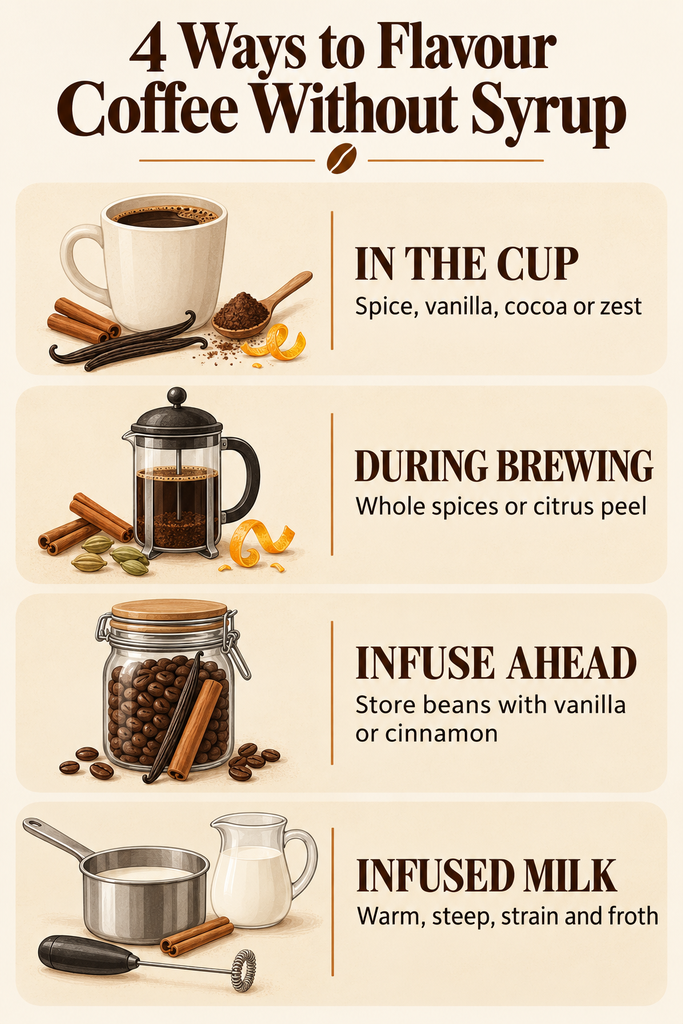
The simplest changes happen after brewing, straight in your mug, and they need no extra kit at all.
- Ground spices: a small pinch of ground cinnamon, nutmeg or cardamom stirred into a finished cup adds warmth without any real prep. Start with a pinch, since these are potent and easy to overdo, and stir well so it doesn’t just sit on top.
- Real vanilla: scrape the seeds from a vanilla pod into your cup, or add a few drops of good vanilla extract (not the artificial “vanilla flavouring” you’ll find on cheaper shelves, which tends to taste thin and slightly chemical). Pod gives a rounder, more floral flavour; extract is quicker, more concentrated, and better for a quick weekday cup.
- Cocoa: a teaspoon of good cocoa powder whisked into a small splash of hot water first, then stirred through the coffee, avoids the clumps and grainy texture you get from adding it dry straight into a full cup.
- Citrus zest: a fine curl of orange or lemon zest dropped into the cup (or into the grounds before brewing) brings a bright, aromatic lift that pairs particularly well with darker roasts. Use a light hand with the pith side, since it’s bitter rather than aromatic.
- A pairing worth trying: vanilla and orange zest together give a flavour close to a chocolate orange, especially over a medium roast, without a scrap of chocolate involved.
None of these need to be used alone, either. A pinch of cinnamon plus a curl of orange zest, or vanilla plus a light dusting of cocoa, both work as combinations rather than single flavours, so there’s plenty of room to find your own favourite once you’re comfortable with the basics.
🔥 Flavouring At Brew Time
For a flavour that runs through the whole cup rather than sitting on top, add your flavouring before or during brewing instead of after.
Whole spices work best here, not powdered ones. A cracked cinnamon stick, a couple of whole cloves, or cardamom pods added directly to the grounds in a cafetière, pour-over filter or moka pot basket will infuse as the water passes through. Powdered spice tends to slip through the filter and leave grit in your cup, so save that for after brewing.
Citrus zest behaves the same way: a strip of peel added to the grounds before brewing infuses gently without any bitterness from the pith.
How well this works varies a little by brew method. A cafetière gives the spice the longest contact time with the water, so it’s the most forgiving method to experiment with. Pour-over is quicker, so flavours come through lighter and cleaner, which suits citrus zest particularly well. A moka pot runs hotter and under pressure, so go easier on strong spices like clove here, since they can turn bitter rather than warm.
🫙 Infusing Beans Or Grounds Ahead Of Time
If you want the flavour built in before you even reach for the kettle, infuse your beans or grounds in advance.
Drop a split vanilla pod or a cinnamon stick into an airtight jar of whole beans and leave it for three to five days, shaking the jar daily so the flavour spreads evenly. Grounds infuse faster, in as little as 24 hours, but they also stale faster once opened, so infuse only as much as you’ll use within a week or two.
This is a good middle ground between the fuss of flavouring every single cup and the flatness of unflavoured coffee, since the work happens once and every brew afterwards is already flavoured.
🥛 Infused Milk As The Flavour Carrier
Milk is probably the most underused flavouring tool in a home coffee setup, and it skips shop-bought flavoured creamers entirely.
Warm your milk (dairy or a creamy oat milk works well here) gently with a split vanilla pod, a cinnamon stick or a couple of cardamom pods, then let it sit off the heat for ten minutes before straining and using as normal. For an even creamier finish, a splash of full-fat barista-style oat milk with real vanilla infused straight in steams and froths in a way that carries the spice right through a latte rather than leaving it floating on top.
Frothing the infused milk properly makes a real difference here, since a good foam holds the aromatics closer to your nose as you drink. A small milk frother makes this a thirty-second job rather than a faff, and it’s worth doing even for a simple flat white.
📏 Ratios, Roast Pairing And Fixing Common Problems
A few rules of thumb make this far less trial-and-error.
- Per 250ml mug: roughly ¼ teaspoon ground spice, or a 5cm strip of citrus zest, or the seeds from a quarter of a vanilla pod, is a sensible starting point. Adjust up gradually rather than dumping it all in at once.
- Roast pairing: lighter roasts carry citrus and floral notes best, since their own flavour doesn’t compete. Medium roasts suit vanilla and cardamom nicely. Darker roasts stand up well to cinnamon, clove and cocoa, which need a bit of bitterness to balance against.
- Bitterness: if your flavoured cup tastes harsh, it’s more often the coffee itself (too fine a grind, or brewed too long) than the flavouring. Fix the brew first before adding more spice to mask it.
- Sediment: if you’re getting grit in the cup, you’ve used powdered spice at brew time rather than whole. Switch to whole spices for infusing, and keep powders for stirring into a finished drink instead.

As a quick reference, a good starting point per 250ml mug looks like this: cinnamon, an eighth to a quarter teaspoon ground, or one small stick infused; vanilla, a quarter pod’s seeds, or two to three drops of extract; cocoa, half a teaspoon, whisked into a splash of hot water first; citrus zest, a 5cm strip, added to the grounds or the cup. Taste before adding more each time, since it’s much easier to build flavour up gradually than to fix an overpowered cup.
🏠 Making It Part of Your Coffee Bar Routine
Once you’ve settled on a favourite flavour or two, it’s worth keeping the kit for it somewhere obvious rather than buried in a cupboard. A small jar of whole spices, a bottle of vanilla extract and a zester kept next to your machine turns this from an occasional experiment into a five-second habit each morning.
If you’re setting up or refreshing your space for this kind of thing, it’s worth a look at how to set up a home coffee bar properly, so the flavouring station has its own spot rather than competing for counter room with everything else.
❓ Common Questions
Can I use flavoured coffee beans instead? You can, and pre-flavoured beans (often coated with a flavoured oil) are a fair shortcut. They tend to go stale faster than plain beans though, since the oil coating degrades, so buy in small bags and expect to use them within a couple of weeks rather than stockpiling.
Will infused beans or milk go off faster? Infused milk should be treated like any other milk and used within its normal fridge life, generally two to three days once opened. Infused beans last as long as any other beans, roughly two to four weeks at best flavour, so infuse only what you’ll get through in that window.
Which spice is easiest to start with? Cinnamon. It’s forgiving on quantity, works at every stage (cup, brew time or infusing ahead), and pairs with almost every other flavour on this list if you want to build up from there.
Do I need special equipment? No. A cafetière, pour-over or moka pot you already own works fine for infusing at brew time, and an airtight jar handles infusing ahead. A milk frother makes the infused-milk method easier, but a small whisk or a jar you shake vigorously will get you a reasonable foam in a pinch.
☕ A Simpler Way To Flavour Your Coffee
None of this needs special equipment or a trip to a specialist shop. A vanilla pod, a couple of cinnamon sticks, some good cocoa and a lemon for zesting will get you further than a shelf of syrups ever did, and you get to decide exactly how sweet (or not) the result is.
If you do want the syrup route for occasions when speed matters more than technique, our guide to the best coffee syrups and how to use them is still there. And if it’s a specific flavour you’re chasing, our dedicated guides to hazelnut flavoured coffee and chocolate flavoured coffee go deeper on those two in particular.